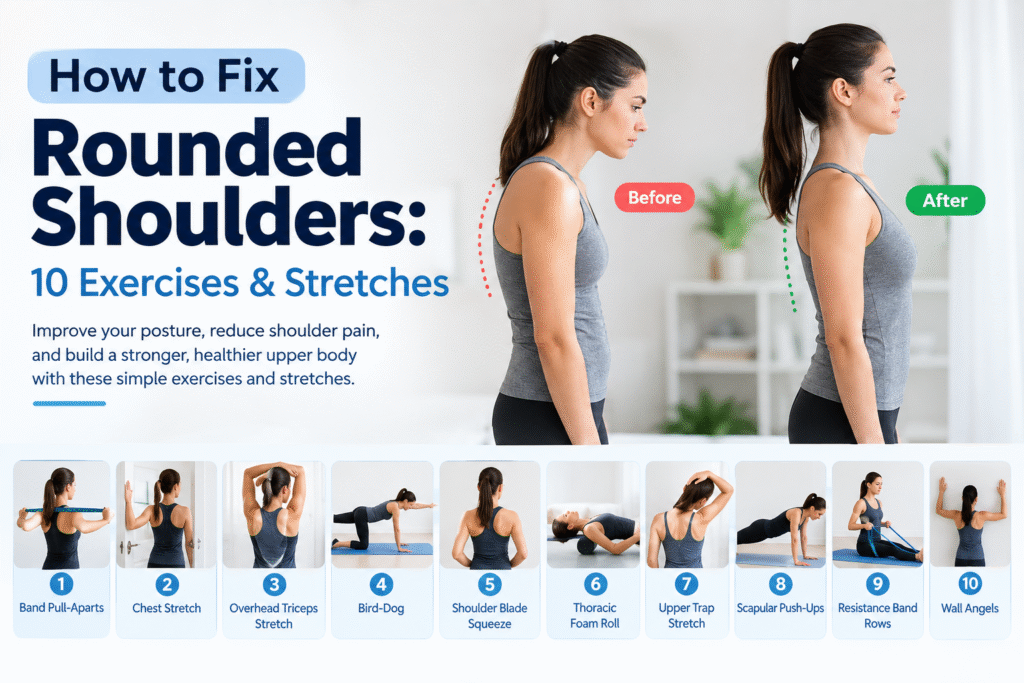
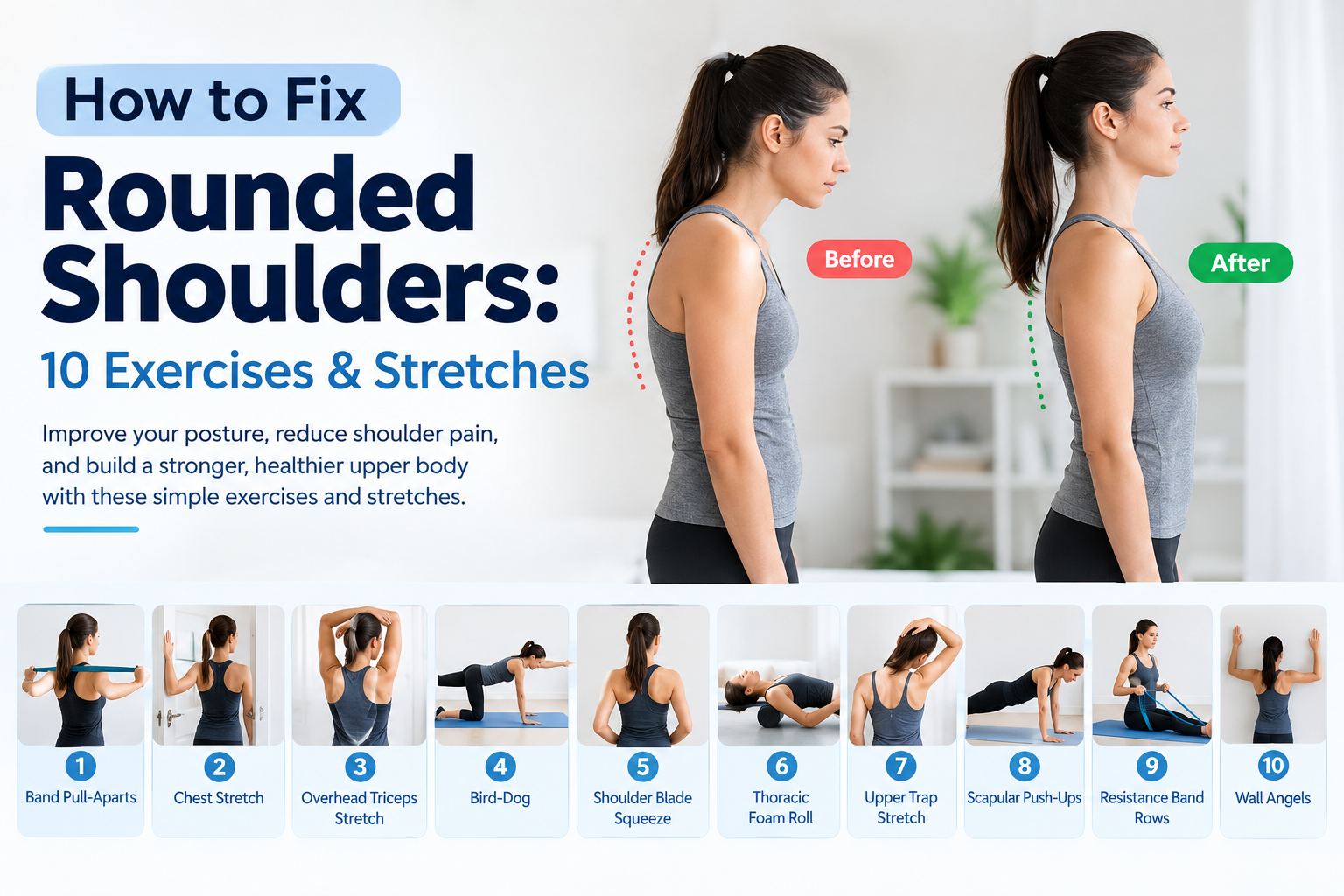
Rounded shoulders develop when your shoulders regularly rest forward from a neutral position. Daily habits, limited mobility, and movement patterns can influence this shoulder posture over time.
Learning how to fix rounded shoulders starts with understanding your individual movement patterns. A balanced approach usually combines mobility exercises, gentle stretching, strengthening, and healthier movement habits.
A practical rounded shoulders correction routine may focus on four important areas:
- Improve mobility through the shoulders and upper back using controlled movements.
- Stretch chest muscles when tightness restricts comfortable shoulder and upper-body movement.
- Strengthen muscles supporting the shoulder blades through progressive, well-controlled resistance exercises.
- Adjust everyday movement habits instead of constantly forcing your shoulders backward.
Consistency matters because posture changes rarely happen after several workouts or stretching sessions. Your progress can also depend on strength, mobility, anatomy, activity, and daily habits.
Rounded shoulders do not automatically indicate an injury or serious medical condition. However, persistent pain, weakness, numbness, or tingling deserves professional medical assessment.
What Are Rounded Shoulders?
Rounded shoulders describe a posture where the shoulders rest forward from their neutral position. This position can make the upper body appear curved, hunched, or slightly slumped.
The shoulder blades may also sit differently against the rib cage during movement. However, shoulder position naturally varies between individuals because bodies have different structures and habits.
Understanding these differences helps you approach rounded shoulders correction without chasing an unrealistic posture.
What Does Rounded Shoulder Posture Look Like?
Rounded shoulder posture often becomes noticeable when viewing your body from the side. Your shoulders may appear positioned forward rather than comfortably aligned with your upper body.
Other visible characteristics may include:
- Shoulder blades appearing more forward around the rib cage during relaxed standing.
- Arms naturally rotating inward while resting alongside your upper body.
- An upper-back position that appears more curved during sitting or standing.
- A forward head position occurring alongside hunched or slumped shoulders.
These signs alone cannot determine whether something is medically wrong with your posture. A professional assessment provides better guidance when symptoms accompany noticeable postural changes.
Rounded Shoulders vs. Normal Shoulder Posture
There is no single proper shoulder posture that every person must maintain constantly. Healthy shoulders naturally change position while sitting, standing, exercising, working, and relaxing.
A comfortable neutral posture generally allows your shoulders to remain relaxed without forced retraction. Your head, rib cage, and pelvis should also feel comfortably balanced during standing.
Good shoulder alignment should support movement rather than create unnecessary muscular tension.
Rounded Shoulders vs. Forward Head Posture
Forward head posture describes the head resting farther forward relative to the torso. Rounded shoulders describe shoulder positioning, although both patterns can sometimes appear together.
Long periods using computers or smartphones may encourage both positions during daily activities. However, one posture pattern does not necessarily mean the other must also exist.
Exercises may therefore address thoracic mobility, shoulder control, and comfortable neck movement together.
Are Rounded Shoulders the Same as Kyphosis?
Rounded shoulders and kyphosis describe different aspects of upper-body posture and spinal shape. Kyphosis refers to the natural outward curvature within the upper thoracic spine.
Everyone has some thoracic curvature, although excessive curvature can have several possible causes. Rounded shoulders mainly describe how the shoulders and shoulder blades rest around the torso.
Therefore, visibly hunched shoulders should not automatically be labeled as spinal kyphosis. Persistent changes, pain, or functional limitations should instead receive appropriate professional evaluation.
What Causes Rounded Shoulders?
Rounded shoulders can develop through several factors affecting movement, mobility, strength, and everyday positioning. There is rarely one specific habit responsible for every person’s shoulder posture.
Genetics, anatomy, training patterns, and daily activities can also influence resting shoulder position. Understanding possible contributors helps you choose more appropriate exercises for rounded shoulders.
Prolonged Sitting and Desk Work
Long periods of sitting can encourage a forward shoulder position during computer-based activities. This becomes more noticeable when your workstation encourages reaching toward the keyboard or screen.
Remaining in one position also reduces opportunities for regular shoulder and upper-back movement. Frequent movement breaks can help restore comfortable motion throughout your working day.
Consider these simple adjustments during prolonged desk work:
- Keep frequently used equipment within comfortable reach instead of constantly leaning forward.
- Change sitting positions regularly rather than trying to maintain one perfect posture.
- Take short movement breaks involving your shoulders, upper back, and entire body.
- Position your screen where viewing does not require excessive forward head movement.
These adjustments support movement variety without forcing your body into rigid proper posture.
Smartphone and Computer Use
Phones and computers often encourage prolonged downward looking and forward-reaching positions during daily use. These habits may contribute to slumped shoulders when maintained for extended periods.
The problem is not necessarily the device itself but limited movement variety. Changing positions regularly may be more practical than maintaining strict alignment continuously.
Raise devices when comfortable and avoid remaining hunched during lengthy browsing sessions.
Muscle Strength, Mobility, and Movement Habits
Shoulder posture depends partly on how several muscles coordinate around your shoulder blades. Strength and mobility limitations can influence how comfortably your shoulders move during daily activities.
Muscles surrounding the chest, upper back, shoulders, and rib cage work together continuously. Therefore, rounded shoulders correction exercises should address movement patterns rather than one muscle alone.
Balanced training can include mobility work alongside progressive strengthening for better shoulder control.
Tight or Restricted Chest Muscles
The pectoralis major and pectoralis minor contribute to movements around your shoulders and chest. Restricted movement around these areas may make certain shoulder positions feel less comfortable.
Gentle chest stretches for rounded shoulders can improve flexibility when genuine restriction exists. However, stretching every day cannot address every possible cause of forward shoulder posture.
Combining appropriate stretching with strengthening usually creates a more complete exercise approach.
Thoracic Spine Mobility
Your thoracic spine forms the upper and middle portion of your spinal column. Its movement can influence how your shoulders and arms function during everyday activities.
Limited thoracic extension may make overhead movements and comfortable shoulder positioning more challenging. Appropriate mobility exercises can gradually improve movement without aggressively forcing spinal extension.
Thoracic mobility should therefore complement, rather than replace, effective shoulder mobility exercises.
Exercise and Training Habits
Your workout routine can influence strength and movement capacity throughout the upper body. Repeatedly training similar movements while neglecting others may create avoidable limitations over time.
A balanced program should develop pushing, pulling, mobility, and shoulder-control abilities appropriately. Rows, controlled pulling exercises, and scapular movements can complement regular pressing exercises effectively.
Training quality and progressive resistance matter more than simply performing countless corrective exercises.
Can Sleeping Position Cause Rounded Shoulders?
Sleeping position alone is unlikely to explain every case of rounded shoulder posture. However, remaining uncomfortable for several hours may temporarily affect stiffness after waking.
Your pillow and sleeping position should primarily support comfortable, restful, uninterrupted sleep. Changing sleep posture should not replace appropriate exercise, mobility, or professional treatment.
Later, we will explain how to sleep to fix rounded shoulders more accurately. That section will focus on comfort and alignment without promising overnight posture correction.
How to Tell If You Have Rounded Shoulders
You can observe your shoulder position using several simple checks at home. These checks may reveal movement patterns but cannot diagnose a medical or structural condition.
Your natural anatomy also influences how your shoulders appear while standing or sitting. Therefore, avoid judging your shoulder posture from one photograph or position alone.
Simple Mirror Posture Check
Stand naturally beside a mirror without deliberately pulling your shoulders backward or downward. Look at how your shoulders, arms, head, and upper back naturally rest.
You may notice several characteristics associated with rounded shoulder posture, including:
- Shoulders resting noticeably forward while your body remains relaxed and comfortable.
- Arms appearing slightly rotated inward when hanging naturally beside your torso.
- Shoulder blades sitting farther around the sides of your rib cage.
- Your head resting forward alongside visibly rounded or hunched shoulders.
Observe these features without trying to immediately correct your standing position.
Wall Posture Check
A wall check can help you understand your comfortable standing position more clearly. Stand against a wall without forcing your spine completely flat against it.
Keep your feet comfortable and allow your shoulders to remain naturally relaxed. Notice whether reaching the wall requires excessive shoulder retraction or uncomfortable spinal movement.
The goal is observing your position rather than passing a strict posture test. Individual anatomy makes universal wall measurements unreliable for identifying problematic shoulder alignment.
Check Your Shoulder and Arm Position
Your resting arm position can provide additional information about your shoulder movement patterns. Let both arms hang naturally without intentionally rotating your hands or shoulders.
Notice whether one shoulder appears significantly different from the opposite side. Also observe whether reaching overhead feels restricted, uncomfortable, or noticeably different between sides.
Movement differences become more relevant when accompanied by pain or reduced daily function.
Check Your Shoulder Mobility
Mobility affects how comfortably your shoulders move through different positions during daily activities. Simple controlled movements can help you notice restrictions without aggressively testing your limits.
Try raising both arms overhead while keeping your movement slow and comfortable. You can also perform gentle wall slides while observing your available movement range.
Stop any self-assessment exercise if it causes sharp pain, numbness, or unusual weakness.
When a Professional Assessment Is Better
Home posture checks cannot identify every reason behind curved or slumped shoulders. A physical therapist or qualified healthcare professional can assess movement, strength, symptoms, and medical history.
Professional evaluation becomes especially valuable when you experience:
- Persistent shoulder, neck, upper-back, or arm pain during everyday activities.
- Numbness, tingling, or unusual weakness affecting your shoulder, hand, or arm.
- Significant differences between your left and right shoulder movement or strength.
- Postural changes appearing suddenly following an accident, injury, or medical condition.
- Symptoms becoming progressively worse despite reasonable changes to activity and exercise.
How to Fix Rounded Shoulders
Learning how to fix rounded shoulders requires more than repeatedly pulling your shoulders backward. A better approach develops mobility, flexibility, strength, and movement control through consistent practice.
Rounded shoulders may have different contributing factors depending on your body and lifestyle. Therefore, your routine should address movement limitations rather than chasing one perfect posture.
A practical rounded shoulders correction strategy can follow five progressive steps:
- Improve mobility: Restore comfortable movement through your thoracic spine and shoulder joints.
- Stretch restricted areas: Address chest or shoulder tightness that limits comfortable movement.
- Build strength: Strengthen muscles supporting controlled movement around your shoulder blades.
- Practice movement: Apply improved shoulder control during workouts and everyday activities.
- Maintain progress: Continue regular movement instead of relying on temporary posture corrections.
This approach combines shoulder mobility exercises with stretching and progressive strengthening techniques. It also reduces dependence on constantly reminding yourself to maintain proper shoulder posture.
Step 1: Improve Thoracic and Shoulder Mobility
Mobility describes your ability to move comfortably through an available range of motion. Improving mobility can make strengthening exercises easier to perform with controlled technique.
Your thoracic spine plays an important role during reaching and overhead shoulder movements. Restricted upper-back movement may encourage compensation elsewhere during exercise and everyday activities.
The following movements can support a rounded shoulders mobility routine:
- Thoracic extensions encourage controlled extension through your middle and upper back.
- Wall slides combine shoulder movement with controlled positioning around your shoulder blades.
- Cat-cow movements gently move your spine between flexion and extension positions.
- Shoulder circles introduce comfortable movement before more demanding upper-body exercises.
Perform each movement slowly instead of forcing your shoulders through uncomfortable positions. Effective shoulder flexibility exercises should create controlled movement without sharp or increasing pain.
Thoracic Extension
Thoracic extensions focus on movement through the upper and middle portion of your back. They can be performed using a chair, foam roller, or similar stable support.
Sit comfortably and place your hands gently behind your head for support. Position the chair edge around your upper-back area while maintaining comfortable spinal control.
Slowly extend your upper back over the support without aggressively arching your lower back. Return to your starting position before repeating the movement with controlled breathing.
Start with a comfortable movement range and increase it gradually when appropriate.
Cat-Cow
Cat-cow provides gentle movement throughout the spine while encouraging controlled upper-back motion. Begin on your hands and knees with your spine comfortably positioned between extremes.
Slowly round your back upward while allowing your head to follow naturally. Then reverse the movement gently while opening your chest without forcing spinal extension.
Move smoothly between both positions while maintaining relaxed, steady breathing throughout each repetition.
Wall Slides
Wall slides combine shoulder mobility with coordinated movement around the scapulae and upper back. Stand against a wall while keeping your body comfortable rather than rigidly flattened.
Place your arms against the wall where the starting position feels manageable. Slowly slide them upward while maintaining controlled and pain-free shoulder movement.
Lower your arms gradually and avoid forcing your hands against the wall. Quality of movement matters more than reaching the highest possible position.
Shoulder Mobility Drill
Controlled arm circles provide a simple way to explore comfortable shoulder range. Stand upright and begin with small circles while keeping your movements smooth.
Gradually increase the circle size without forcing uncomfortable ranges or excessive spinal movement. Reverse direction after completing several controlled repetitions on the first side.
These mobility exercises prepare your shoulders for stretching and strengthening work that follows.
Step 2: Stretch the Chest and Front of Your Shoulders
Stretching can help when restricted chest muscles limit comfortable shoulder and upper-body movement. However, stretches for rounded shoulders should complement strengthening rather than become your entire routine.
The pectoralis major and pectoralis minor influence movement around your chest and shoulders. Gentle stretching may improve flexibility when these areas feel particularly tight or restricted.
Avoid aggressively pulling your shoulders backward while performing the following stretches. Instead, use controlled positions that create mild tension without producing pain.
1. Doorway Chest Stretch
The doorway stretch provides a simple way to stretch your chest muscles comfortably. It requires no specialized equipment and works well within a daily mobility routine.
To perform the doorway chest stretch:
- Stand inside a doorway and place one forearm against the doorframe.
- Keep your shoulder relaxed rather than deliberately pulling it backward or downward.
- Step forward gently until you notice comfortable tension across your chest.
- Maintain steady breathing while avoiding excessive arching through your lower back.
- Repeat on the opposite side using the same comfortable movement range.
Hold the stretch briefly while keeping the sensation mild and controlled. Stop if you experience sharp pain, tingling, numbness, or increasing shoulder discomfort.
This movement is among the most accessible chest stretches for rounded shoulders.
2. Pec Minor Stretch
The pectoralis minor lies beneath the larger pectoralis major muscle in your chest. It attaches to the ribs and the coracoid process of your shoulder blade.
A doorway position can also create a gentle stretch around this region. Place your arm comfortably against the frame without raising it beyond your tolerance.
Move your torso forward gradually until mild chest tension becomes noticeable. Avoid forcing deeper movement simply because a stronger stretch feels more effective.
Comfortable, repeatable movement is generally more useful than aggressive stretching.
3. Wall Chest Stretch
A wall chest stretch allows each side to be addressed independently and gradually. Stand beside a wall and place your palm or forearm against it.
Slowly rotate your torso away until you feel gentle tension across your chest. Keep your shoulder comfortable and avoid twisting aggressively through your lower back.
Useful technique reminders include:
- Keep your breathing relaxed instead of holding your breath during stretching.
- Reduce your range whenever the shoulder joint itself becomes uncomfortable.
- Maintain a gentle stretch rather than chasing maximum flexibility immediately.
- Compare both sides without expecting identical flexibility or movement from each shoulder.
This variation can support shoulder flexibility exercises within a broader correction program.
4. Gentle Neck and Upper-Body Stretch
Neck tension sometimes accompanies prolonged sitting, computer work, and hunched shoulders. Gentle movement can help restore comfortable motion after extended periods without activity.
Sit or stand comfortably while keeping your shoulders relaxed and breathing normally. Slowly tilt your head toward one side without pulling aggressively with your hand.
Return to the center before repeating the movement toward your opposite side. You can also perform gentle neck rotations within your comfortable available range.
Neck stretching should never produce dizziness, radiating pain, numbness, or tingling sensations.
How Often Should You Stretch Rounded Shoulders?
There is no universal stretching schedule that works perfectly for every individual. Frequency should depend on your mobility, training program, comfort, and professional recommendations.
Short stretching sessions can fit naturally after prolonged sitting or regular workouts. More stretching is not automatically better when your mobility is already adequate.
Most importantly, stretching alone cannot guarantee permanent changes in rounded shoulder posture.
Step 3: Strengthen Muscles Supporting Better Shoulder Position
Strengthening helps your shoulders move efficiently during workouts and everyday activities. It also complements mobility work and stretches for rounded shoulders within a balanced routine.
The goal is not keeping your shoulder blades permanently squeezed together. Instead, strengthening should improve controlled movement across different positions and activities.
Several muscles contribute to shoulder movement, including the trapezius, serratus anterior, and rotator cuff. The rhomboids and surrounding upper-back muscles also participate in scapular movement and stability.
The following exercises for rounded shoulders target these areas through different movement patterns.
5. Band Pull-Aparts
Band pull-aparts strengthen muscles around your upper back and posterior shoulders. They are simple to perform and require only a light resistance band.
To perform band pull-aparts:
- Hold a resistance band using both hands around shoulder-width apart.
- Extend your arms forward while keeping your shoulders relaxed and comfortable.
- Pull the band apart using controlled movement without excessively arching backward.
- Pause briefly when your arms reach a comfortable outward position.
- Slowly return to your starting position while maintaining tension and control.
Choose resistance that allows smooth repetitions without compensating through your neck or lower back.
6. Face Pulls
Face pulls train several upper-back and shoulder muscles through a controlled pulling pattern. You can perform them using a cable machine or properly anchored resistance band.
Begin with your arms extended while holding the rope or resistance band securely. Pull toward your face while allowing your elbows to move outward comfortably.
Control the returning movement instead of letting the resistance quickly pull your arms forward. Keep your neck relaxed and avoid shrugging excessively during each repetition.
Face pulls can complement other shoulder alignment exercises within a progressive strength program.
7. Wall Angels
Wall angels combine shoulder mobility with controlled upper-back and shoulder movement. They can also reveal movement restrictions that become noticeable during overhead arm positions.
Stand against a wall without forcing your entire spine completely flat. Position your arms comfortably against the wall with your elbows bent.
Slowly move your arms upward while maintaining a pain-free and controlled range. Lower them gradually without forcing your wrists or elbows against the surface.
Reduce your movement range if maintaining wall contact creates discomfort or excessive compensation.
8. Y-T-W Raises
Y-T-W raises use three arm positions to train controlled shoulder-blade movement. They can be performed standing, bent forward, or supported on an incline bench.
Begin without weights until you can perform each position comfortably. Move your arms into these three patterns:
- Y position: Raise your arms diagonally overhead while maintaining relaxed shoulder movement.
- T position: Extend your arms outward to create a controlled horizontal line.
- W position: Bend your elbows while drawing them downward into a W-shape.
Focus on controlled movement instead of aggressively squeezing your shoulder blades together. Light resistance is usually sufficient when learning these movement patterns.
9. Resistance-Band or Cable Rows
Rows strengthen your back through a horizontal pulling movement commonly used during strength training. They can support a balanced rounded shoulders workout when performed with controlled technique.
Begin with your arms extended and maintain a comfortable upright torso position. Pull the handles toward your body while allowing your elbows to travel backward.
Avoid aggressively pushing your chest forward or exaggerating shoulder-blade retraction. Return slowly until your arms extend comfortably before beginning another repetition.
Progress resistance gradually while maintaining consistent movement quality throughout every set.
10. Push-Up Plus
The push-up plus emphasizes serratus anterior activity through additional shoulder-blade movement. This muscle contributes significantly to controlled scapular movement around your rib cage.
Begin in a wall, elevated, kneeling, or standard push-up position. Choose the variation that allows you to maintain comfortable and controlled technique.
After completing the pushing movement, gently push farther away from the surface. Allow your shoulder blades to move around your rib cage without rounding excessively elsewhere.
Return with control before performing the next repetition.
How to Choose the Best Exercises for Rounded Shoulders
The best exercises for rounded shoulders depend on your mobility and current strength. Available equipment, symptoms, training experience, and movement tolerance also influence exercise selection.
Beginners can start with several manageable movements rather than performing everything immediately:
- Choose one exercise targeting thoracic or shoulder mobility.
- Include one comfortable chest stretch when flexibility feels restricted.
- Select two strengthening movements using manageable resistance and controlled technique.
- Progress repetitions or resistance gradually as your strength and control improve.
Exercise selection should remain individualized because rounded shoulders have multiple possible contributing factors. Painful exercises should be modified or assessed instead of repeatedly performed through discomfort.
Best Exercises for Rounded Shoulders: Quick Comparison
Choosing the best exercises for rounded shoulders becomes easier when you understand each movement. Some exercises improve mobility, while others develop strength, flexibility, or shoulder-blade control.
You do not need to perform every exercise during each workout. Choose movements that match your current mobility, strength, experience, and available equipment.
| Exercise | Primary Purpose | Main Area | Equipment | Level |
| Doorway Chest Stretch | Flexibility | Chest and front shoulders | Doorway | Beginner |
| Thoracic Extension | Mobility | Thoracic spine | Chair or foam roller | Beginner |
| Cat-Cow | Mobility | Spine and upper back | None | Beginner |
| Wall Slides | Mobility and control | Shoulders and scapulae | Wall | Beginner |
| Band Pull-Aparts | Strength | Upper back and posterior shoulders | Resistance band | Beginner |
| Face Pulls | Strength and control | Upper back and shoulders | Band or cable | Intermediate |
| Wall Angels | Mobility and control | Shoulders and upper back | Wall | Beginner |
| Y-T-W Raises | Strength and control | Scapular muscles | Optional light weights | Intermediate |
| Rows | Strength | Back and shoulders | Band, cable, or weights | Beginner–Intermediate |
| Push-Up Plus | Strength and control | Serratus anterior | None | Beginner–Intermediate |
Which Exercise Should You Start With?
Beginners should usually prioritize movements they can perform comfortably with controlled technique. Starting with easier variations also provides opportunities to understand your current movement limitations.
A simple starting combination could include:
- Thoracic extensions for controlled upper-back mobility before strengthening exercises.
- Doorway chest stretches when chest tightness limits comfortable shoulder movement.
- Wall slides for shoulder mobility and coordinated shoulder-blade movement.
- Band pull-aparts for accessible upper-back and posterior shoulder strengthening.
- Rows for developing controlled horizontal pulling strength through progressive resistance.
These movements cover several components involved in improving rounded shoulder posture. Your routine can gradually expand as strength, mobility, and exercise technique improve.
Should You Use Weights for Rounded Shoulder Exercises?
Weights are not required when beginning rounded shoulder exercises or mobility training. Bodyweight and resistance bands provide enough challenge for many introductory movements.
Additional resistance becomes useful when exercises feel easy with consistently controlled technique. Progress gradually rather than choosing heavy weights that compromise your movement quality.
Strengthening should challenge your muscles without creating sharp pain or uncontrolled compensations.
10-Minute Rounded Shoulders Workout
A short routine makes consistent posture-focused training easier to include within busy schedules. This rounded shoulders workout combines mobility, flexibility, strength, and controlled shoulder-blade movement.
You can perform the routine independently or before your regular upper-body training. Move slowly and select resistance that allows comfortable technique throughout every exercise.
Warm-Up: 2 Minutes
Begin with gentle movement to prepare your shoulders and upper back for exercise. The goal is comfortable motion rather than aggressively increasing your available range.
Perform these movements consecutively:
- Cat-cow: Complete six to eight slow repetitions using relaxed, controlled breathing.
- Shoulder circles: Perform several circles forward before gradually reversing the movement direction.
- Wall slides: Complete six controlled repetitions within your comfortable overhead movement range.
Your shoulders should feel warmer and more mobile without becoming fatigued.
Mobility and Stretching: 3 Minutes
Next, focus on thoracic movement and chest flexibility before beginning strengthening exercises. These movements can be particularly useful after prolonged sitting or computer work.
Complete the following sequence:
- Thoracic extension: Perform six to eight controlled repetitions over a stable support.
- Doorway chest stretch: Hold gently before repeating the stretch on your opposite side.
- Wall chest stretch: Use a comfortable range without forcing additional shoulder rotation.
Keep each stretch mild enough to maintain relaxed breathing throughout the position.
Strengthening: 5 Minutes
The strengthening portion develops upper-back, shoulder, and scapular control through simple movements. Beginners should prioritize technique before increasing resistance, repetitions, or exercise difficulty.
Perform two rounds of these exercises:
- Band pull-aparts: Complete eight to twelve repetitions using light, manageable resistance.
- Rows: Perform eight to twelve controlled repetitions without excessive shoulder retraction.
- Wall angels: Complete six to ten repetitions within your comfortable movement range.
- Push-up plus: Perform six to ten controlled repetitions using an appropriate variation.
Rest briefly whenever fatigue begins affecting your movement quality or breathing.
How Often Should You Do This Workout?
Consistency is more valuable than performing an unnecessarily demanding routine every day. Your ideal frequency depends on training experience, recovery, symptoms, and existing exercise habits.
You can initially incorporate these movements several times throughout your weekly training schedule. Some gentle shoulder mobility exercises may also fit comfortably into regular movement breaks.
Avoid increasing every variable simultaneously when your routine begins feeling easier. Instead, gradually adjust resistance, repetitions, movement range, or exercise complexity individually.
How to Progress Your Rounded Shoulders Workout
Progressive exercise gives your muscles increasing challenges as strength and movement control improve. However, progression should remain gradual rather than turning corrective work into maximum-effort training.
Consider progressing when your current routine feels consistently comfortable and technically controlled:
- Increase repetitions slightly while maintaining the same resistance and movement quality.
- Choose a moderately stronger resistance band for pull-aparts or rowing exercises.
- Progress from wall push-up plus toward elevated or floor-based variations.
- Increase comfortable movement range without forcing your shoulders into painful positions.
- Add another controlled set when your current training volume feels easily manageable.
Record your exercises occasionally to identify improvements in strength and movement quality. Avoid judging progress entirely through photographs because posture naturally changes throughout each day.
How to Improve Shoulder Posture Throughout the Day
Exercise can improve strength and mobility, but daily movement habits also deserve attention. Your shoulders constantly change position while working, walking, exercising, driving, and relaxing.
Improving shoulder posture does not mean maintaining one rigid position throughout the day. Instead, aim for comfortable movement variety and reduce unnecessarily prolonged static positions.
Improve Your Desk and Computer Setup
Desk work can encourage forward reaching when your equipment sits too far away. Small workstation adjustments may reduce unnecessary strain during extended periods of computer use.
Consider these practical changes:
- Position your keyboard and mouse where your elbows can remain comfortably nearby.
- Place your monitor at a comfortable height that reduces excessive downward viewing.
- Keep frequently used objects within reach to minimize repetitive forward shoulder leaning.
- Use a supportive chair that allows comfortable changes in your sitting position.
- Stand and move periodically instead of remaining seated for several continuous hours.
Your workstation should support movement rather than force an artificial neutral posture continuously.
Change How You Use Your Phone
Smartphone use commonly involves looking downward while allowing the shoulders to move forward. This position is not automatically harmful, especially when you change positions regularly.
Try bringing your phone higher when extended downward viewing becomes uncomfortable. Support your arms when possible to reduce unnecessary tension around your neck and shoulders.
More importantly, take regular breaks during lengthy browsing or scrolling sessions.
Avoid Staying in One Position Too Long
The body is designed to move through many different positions during daily activities. Even a seemingly proper posture can become uncomfortable when maintained for extended periods.
Alternate between sitting, standing, walking, and other comfortable positions whenever your environment allows. Brief movement breaks can include shoulder circles, walking, reaching, or gentle upper-back mobility.
These habits encourage movement variety without making posture correction feel like constant work.
Should You Pull Your Shoulders Back All Day?
Constantly squeezing your shoulder blades together is unnecessary for improving rounded shoulder posture. This strategy may create fatigue and tension without addressing strength or mobility limitations.
Instead, allow your shoulder blades to move naturally during reaching and everyday activities. Use strengthening exercises to improve control rather than holding one position continuously.
Comfortable posture should feel sustainable rather than tense, exaggerated, or physically demanding.
Practice Better Movement During Exercise
Gym technique provides another opportunity to develop controlled shoulder movement and strength. Focus on appropriate movement rather than forcing your shoulders into excessive retraction during every exercise.
During upper-body training:
- Use resistance that allows controlled movement throughout your available range.
- Avoid shrugging unnecessarily when exercises require stable and controlled shoulder movement.
- Balance pushing and pulling exercises according to your individual training requirements.
- Include mobility work when restricted movement interferes with comfortable exercise technique.
- Progress resistance gradually as your strength and movement confidence improve.
Good training develops adaptable shoulders rather than creating one permanently fixed position.
Build Habits You Can Maintain
Postural habits improve more effectively when changes fit naturally into your daily routine. Complicated correction strategies often become difficult to maintain consistently over several weeks.
Start with manageable actions like movement breaks, regular exercise, and workstation adjustments. Combine these habits with your rounded shoulders correction exercises for a balanced approach.
How to Sleep to Help Rounded Shoulders
People searching how to sleep to fix rounded shoulders often expect one ideal position. However, sleeping posture alone is unlikely to correct rounded shoulders or permanently change alignment.
A better goal is finding a position supporting comfortable, uninterrupted, restorative sleep. Your neck and shoulders should feel supported without creating unnecessary pressure or tension.
Is Back Sleeping Better for Shoulder Posture?
Sleeping on your back can provide comfortable support for some people’s necks and shoulders. This position also avoids placing your entire body weight directly onto one shoulder.
Choose a pillow that supports your head without excessively pushing it forward. Your neck should feel comfortable rather than deliberately flattened against the mattress.
Placing your arms comfortably beside your body may also reduce unnecessary shoulder tension. However, you do not need to force yourself into back sleeping.
Side Sleeping and Shoulder Position
Side sleeping is common and does not automatically cause round shoulders or poor posture. Comfort depends partly on mattress support, pillow height, and individual body structure.
When sleeping on your side, avoid trapping your lower arm underneath your body. A pillow supporting your upper arm may feel comfortable for some sleepers.
Your head pillow should support your neck without creating excessive sideways bending. If shoulder pressure becomes uncomfortable, adjusting your position may provide better relief.
Does Stomach Sleeping Affect Shoulder Posture?
Stomach sleeping often requires rotating your head toward one side for extended periods. Your arms may also remain overhead or beside your body depending on preference.
This position is not automatically responsible for rounded shoulder posture. However, change positions when stomach sleeping repeatedly causes neck or shoulder discomfort.
Sleep quality and comfort remain more important than maintaining a theoretically perfect position.
Choosing a Pillow for Comfortable Alignment
No single pillow height provides ideal shoulder alignment for every sleeper. Body proportions, mattress firmness, sleeping position, and personal comfort influence appropriate pillow support.
When evaluating your pillow, consider whether:
- Your neck feels comfortably supported without excessive bending or rotation.
- You frequently wake with new neck, shoulder, or upper-back discomfort.
- Your head feels pushed unusually forward when sleeping on your back.
- Side sleeping creates an uncomfortable gap between your head and mattress.
A comfortable pillow should support sleep without forcing your body into rigid alignment.
Can Changing Your Sleep Position Fix Rounded Shoulders?
Changing sleeping positions alone should not be considered a complete posture correction strategy. Rounded shoulders can involve strength, mobility, anatomy, habits, and other individual factors.
Instead, combine comfortable sleeping habits with regular mobility and progressive strengthening exercises. Address persistent nighttime shoulder pain with an appropriate healthcare professional when necessary.
How Long Does It Take to Fix Rounded Shoulders?
There is no universal timeline for improving rounded shoulders through exercise and mobility. Progress varies because shoulder posture is influenced by several individual and lifestyle factors.
Some people may notice better movement awareness before seeing noticeable postural changes. Strength, mobility, and exercise technique can also improve at different rates.
Your progress may depend on:
- Current mobility: Greater movement restrictions may require more gradual mobility-focused training.
- Strength levels: Building meaningful muscular strength generally requires consistent progressive training.
- Daily habits: Long periods without movement can influence how your shoulders feel.
- Training consistency: Regular practice usually provides better opportunities for gradual physical adaptation.
- Individual anatomy: Natural skeletal structure influences resting posture and visible shoulder position.
- Existing symptoms: Pain or injury may require professional assessment before progressing exercises.
Rather than expecting a specific deadline, monitor changes in movement quality and function. Improved exercise control can be meaningful even before visible posture changes become noticeable.
What Progress Should You Look For?
Photographs can show changes, but appearance should not become your only measurement. Functional improvements often provide more useful information about how your shoulders are adapting.
Look for changes such as:
- Overhead movements becoming smoother and more comfortable during regular activities.
- Better control while performing rows, wall slides, and other shoulder exercises.
- Reduced feelings of stiffness after prolonged sitting or computer-based work.
- Greater confidence using comfortable ranges during upper-body strength training.
- Improved consistency with your mobility, strengthening, and daily movement routine.
These improvements can indicate progress without requiring perfectly symmetrical shoulder alignment.
Can You Fix Rounded Shoulders Quickly?
Claims promising to permanently correct rounded shoulders within several days deserve caution. Physical adaptations involving strength and movement generally require repeated training and adequate recovery.
Trying to accelerate progress through aggressive stretching may create unnecessary discomfort. Excessive corrective exercise can also interfere with recovery from regular strength training.
A sustainable approach combines exercises to fix rounded shoulders with normal full-body movement. Progress your routine gradually while allowing enough recovery between demanding strengthening sessions.
When Should You Reassess Your Routine?
Review your routine when exercises become consistently easy or stop feeling appropriate. You may need additional resistance, different movements, or professional guidance depending on progress.
Persistent pain, weakness, numbness, or worsening symptoms should not simply be trained through. Seek appropriate healthcare assessment when these problems affect daily activities or exercise.
Common Mistakes When Trying to Correct Rounded Shoulders
Improving rounded shoulders requires consistency, but more corrective exercise is not always better. Certain habits can make your routine uncomfortable, ineffective, or unnecessarily difficult to maintain.
Understanding these common mistakes helps you build a safer and more balanced approach.
Only Stretching Your Chest
Chest tightness can influence comfortable shoulder movement for some people. However, stretching alone does not develop strength or improve control around your shoulder blades.
Combine appropriate stretching with mobility and progressive upper-body strengthening. This approach addresses more factors than repeatedly performing chest stretches for rounded shoulders.
Pulling Your Shoulders Back Too Hard
Many people attempt rounded shoulders correction by constantly squeezing their shoulder blades together. This position can create unnecessary tension when maintained throughout your entire day.
Your shoulder blades need to move naturally during reaching, lifting, pushing, and pulling. Focus on controlled movement instead of permanently holding your shoulders backward.
Ignoring Thoracic Mobility
Your upper back contributes to reaching, rotation, and overhead shoulder movements. Limited thoracic movement may make certain exercises more difficult to perform comfortably.
Include appropriate thoracic mobility alongside your regular shoulder mobility exercises. Avoid forcing extension when your movement becomes painful or difficult to control.
Using Too Much Resistance
Heavy resistance does not automatically make rounded shoulder exercises more effective. Excessive loading can encourage shrugging, momentum, and other unwanted compensations during training.
Choose resistance that allows controlled repetitions throughout your comfortable movement range. Increase the challenge gradually after your exercise technique becomes consistently reliable.
Performing Exercises Too Quickly
Fast repetitions can make it harder to notice how your shoulders move. Controlled movement gives you more opportunity to maintain technique throughout each exercise.
Slow down when performing wall slides, rows, pull-aparts, and similar movements. Quality repetitions generally provide more useful practice than rushing through additional repetitions.
Training Only Your Upper Back
Upper-back strengthening can support a well-rounded program, but posture involves more than one region. Shoulder mobility, thoracic movement, general strength, and daily activity also deserve attention.
Continue training your entire body instead of creating an unnecessarily narrow corrective program. Balanced strength supports everyday movement beyond improving shoulder posture alone.
Expecting Perfect Posture All Day
No healthy body remains perfectly aligned throughout every waking hour. Your posture naturally changes according to your activity, environment, comfort, and fatigue.
Instead of constantly checking your shoulders, prioritize regular movement and comfortable positioning. Proper posture should support function rather than become a rigid position you maintain.
Expecting Overnight Results
Strength, mobility, and movement control generally improve through repeated practice over time. Avoid programs promising permanent correction after only several workouts or stretching sessions.
Track improvements in comfort, exercise technique, mobility, and strength alongside appearance. These measures provide a broader understanding of your progress.
Ignoring Pain, Numbness, or Weakness
Corrective exercises should not become a method for repeatedly training through concerning symptoms. Persistent pain can have causes unrelated to ordinary posture or muscular tightness.
Stop or modify movements that consistently reproduce significant symptoms during training. Seek professional assessment when numbness, tingling, weakness, or persistent pain affects normal activities.
A thoughtful approach focuses on building capacity rather than forcing your body into alignment.
Can Rounded Shoulders Be Fixed Naturally?
Many people searching how to correct rounded shoulders naturally want solutions without specialized treatments. Exercise and daily movement changes may improve posture when appropriate for individual needs.
However, “natural correction” should not imply that every shoulder position requires fixing. Your anatomy, mobility, strength, lifestyle, and health can influence your resting posture.
A practical approach usually combines several strategies rather than depending on one exercise.
Build Strength Gradually
Progressive strength training can improve your ability to control different shoulder positions. Rows, face pulls, and similar movements develop useful upper-body pulling strength.
Exercises targeting scapular control can also complement a complete strength-training program. Increase resistance gradually instead of performing excessive amounts of corrective exercise.
Improve Shoulder and Upper-Back Mobility
Comfortable mobility allows your shoulders to move through useful ranges during everyday activities. Thoracic extensions and wall slides can support movement when restrictions are present.
Regular shoulder flexibility exercises may also help when stiffness limits comfortable movement. Mobility training should remain controlled and should never require pushing through sharp pain.
Stretch Areas That Feel Restricted
Gentle stretching can complement strengthening when your chest or shoulders feel restricted. Doorway stretches provide one accessible option requiring almost no equipment.
Avoid assuming every person with curved shoulders automatically has shortened chest muscles. Stretching should address genuine movement limitations rather than simply follow a posture stereotype.
Increase Daily Movement
Exercise sessions represent only a small portion of your entire day. Regular movement can help prevent long periods spent continuously sitting or leaning forward.
Simple habits can make your routine easier to maintain:
- Walk briefly after extended periods of sitting or computer-based work.
- Change working positions when remaining stationary begins feeling uncomfortable.
- Include gentle shoulder movements during breaks throughout your working day.
- Continue regular full-body exercise alongside specific posture-focused movements.
These habits support general movement without requiring constant monitoring of your shoulders.
Do You Need a Posture Corrector?
A posture brace or wearable device may provide temporary positional feedback. However, passive support cannot replace progressive strengthening, mobility, and regular physical activity.
Depending on a device may also discourage development of active movement control. Seek professional guidance when considering braces for pain, injury, or medical conditions.
Do You Need Special Equipment?
Most exercises to correct rounded shoulders require little or no specialized equipment. A resistance band, wall, stable chair, and exercise mat provide several useful options.
Gym equipment can help you progressively strengthen muscles as your abilities improve. Still, consistency and exercise quality matter more than owning specialized posture products.
For many people, improving movement naturally involves mobility, strength, activity, and sustainable habits.
When Should You See a Physical Therapist or Doctor?
Rounded shoulders without pain do not automatically indicate an underlying medical problem. However, posture changes accompanied by persistent symptoms may require professional evaluation.
A physical therapist can assess mobility, strength, movement patterns, and functional limitations. A doctor may investigate symptoms suggesting an injury or another underlying condition.
Consider seeking professional guidance when you experience:
- Persistent shoulder, neck, or upper-back pain that interferes with normal activities.
- Numbness or tingling traveling through your shoulder, arm, hand, or fingers.
- Noticeable weakness affecting your ability to lift, push, pull, or grip.
- Significant loss of shoulder movement that develops unexpectedly or progressively worsens.
- Visible posture changes appearing suddenly after an accident or physical injury.
- Symptoms that continue worsening despite modifying uncomfortable exercises and daily activities.
- Breathing difficulties occurring alongside significant or rapidly changing upper-body posture.
These symptoms should not simply be treated with additional rounded shoulder exercises.
How Can a Physical Therapist Help?
A physical therapist can determine which movements are limited and which remain comfortable. Assessment may include shoulder mobility, strength, scapular movement, and functional activity patterns.
Your therapist can then select exercises based on those individual findings. This approach is more specific than following generalized rounded shoulders correction exercises online.
They can also modify exercises when pain or previous injuries affect movement.
When Is Medical Evaluation More Appropriate?
Medical evaluation becomes important when symptoms suggest more than ordinary postural variation. Sudden weakness, significant injury, or neurological symptoms deserve particular attention.
A healthcare professional can determine whether additional examination or testing becomes necessary. This helps separate posture-related concerns from conditions requiring specific medical management.
Exercise Should Support Function, Not Replace Medical Care
Mobility and strengthening exercises can support healthy movement and physical capacity. They should not replace appropriate medical care when significant symptoms are present.
Avoid diagnosing pain based solely on the appearance of hunched shoulders. Similar symptoms can arise from different conditions requiring different approaches.
If exercises remain comfortable and symptoms are absent, gradual progression may be appropriate.
Frequently Asked Questions About Rounded Shoulders
The following answers address common questions about rounded shoulders, exercises, stretching, and posture. Individual results vary because shoulder position depends on anatomy, movement, strength, and lifestyle.
What Is the Best Exercise for Rounded Shoulders?
There is no single best exercise for rounded shoulders that suits everyone. Effective programs usually combine mobility, stretching when needed, and progressive upper-body strengthening.
Wall slides, rows, band pull-aparts, and thoracic extensions provide useful starting options. Choose exercises according to your mobility, strength, symptoms, and available equipment.
Can Rounded Shoulders Actually Be Corrected?
Rounded shoulder posture may improve through consistent exercise and better movement habits. However, visible changes depend partly on anatomy and individual contributing factors.
Focus on improving mobility, strength, comfort, and function rather than achieving perfect alignment.
How Long Does It Take to Fix Rounded Shoulders?
There is no reliable timeframe that applies to every person with rounded shoulders. Progress depends on strength, mobility, consistency, anatomy, symptoms, and everyday movement habits.
Meaningful strength and movement adaptations generally require consistent training rather than quick corrections.
Can You Fix Rounded Shoulders With Exercise?
Exercise may improve strength, mobility, and movement control associated with shoulder posture. A complete program can combine mobility exercises, stretching, strengthening, and general physical activity.
Exercise cannot guarantee identical postural changes for everyone because individual anatomy varies considerably.
Do Chest Stretches Help Rounded Shoulders?
Chest stretches for rounded shoulders may help when restricted chest mobility affects movement. Doorway and wall stretches provide accessible options for gently exploring chest flexibility.
Stretching should complement strengthening rather than serve as your only correction strategy.
Can Sleeping on Your Back Fix Rounded Shoulders?
Back sleeping alone is unlikely to permanently change rounded shoulder posture. Choose sleeping positions supporting comfort, restful sleep, and appropriate neck and shoulder support.
Exercise and daily movement habits provide more active ways to develop physical capacity.
Are Rounded Shoulders Caused by Weak Back Muscles?
Weakness may contribute to movement limitations, but rounded shoulders rarely have one universal cause. Anatomy, mobility, habits, training, and muscular capacity can influence resting shoulder position.
Therefore, strengthening only your back may not address every contributing factor.
Should I Keep My Shoulders Pulled Back All Day?
No, your shoulder blades should move naturally during normal activities and exercise. Constantly squeezing them backward can create unnecessary muscular tension and fatigue.
Aim for comfortable, adaptable movement instead of maintaining one rigid proper posture.
Do Rows Help Rounded Shoulders?
Rows strengthen several muscles involved in upper-back and shoulder movement. They can therefore contribute to a balanced rounded shoulders workout alongside mobility exercises.
Use controlled resistance and avoid exaggerating shoulder-blade retraction during each repetition.
Can Rounded Shoulders Cause Neck or Shoulder Pain?
Rounded shoulders and discomfort can sometimes occur together, but association does not prove causation. Neck or shoulder pain can develop from many different physical and medical factors.
Persistent or worsening pain should receive appropriate professional assessment rather than posture-based self-diagnosis.