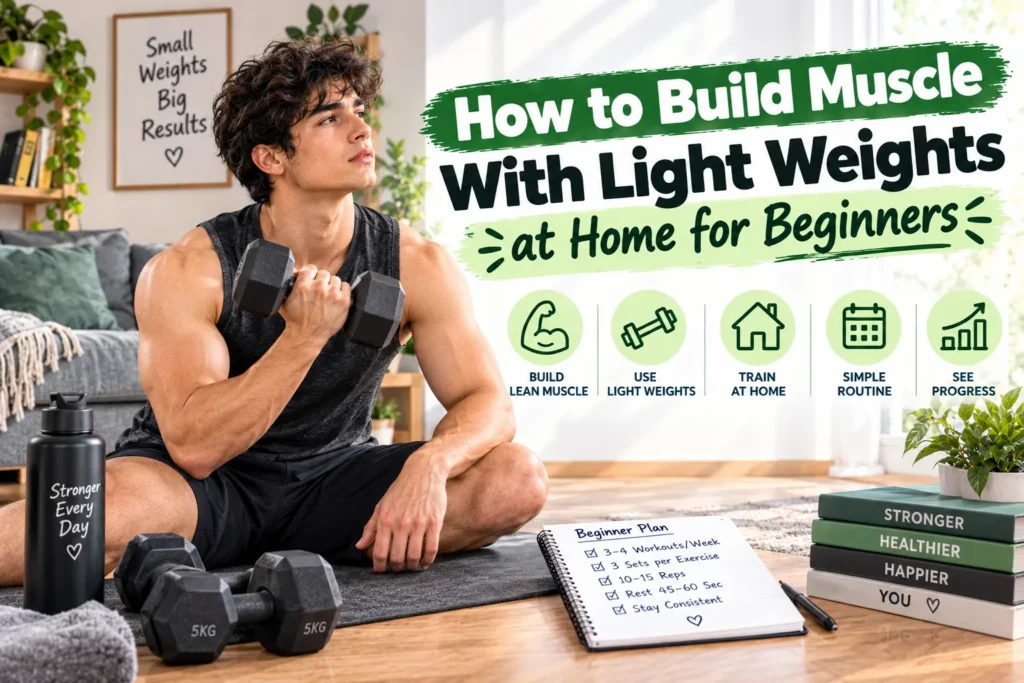
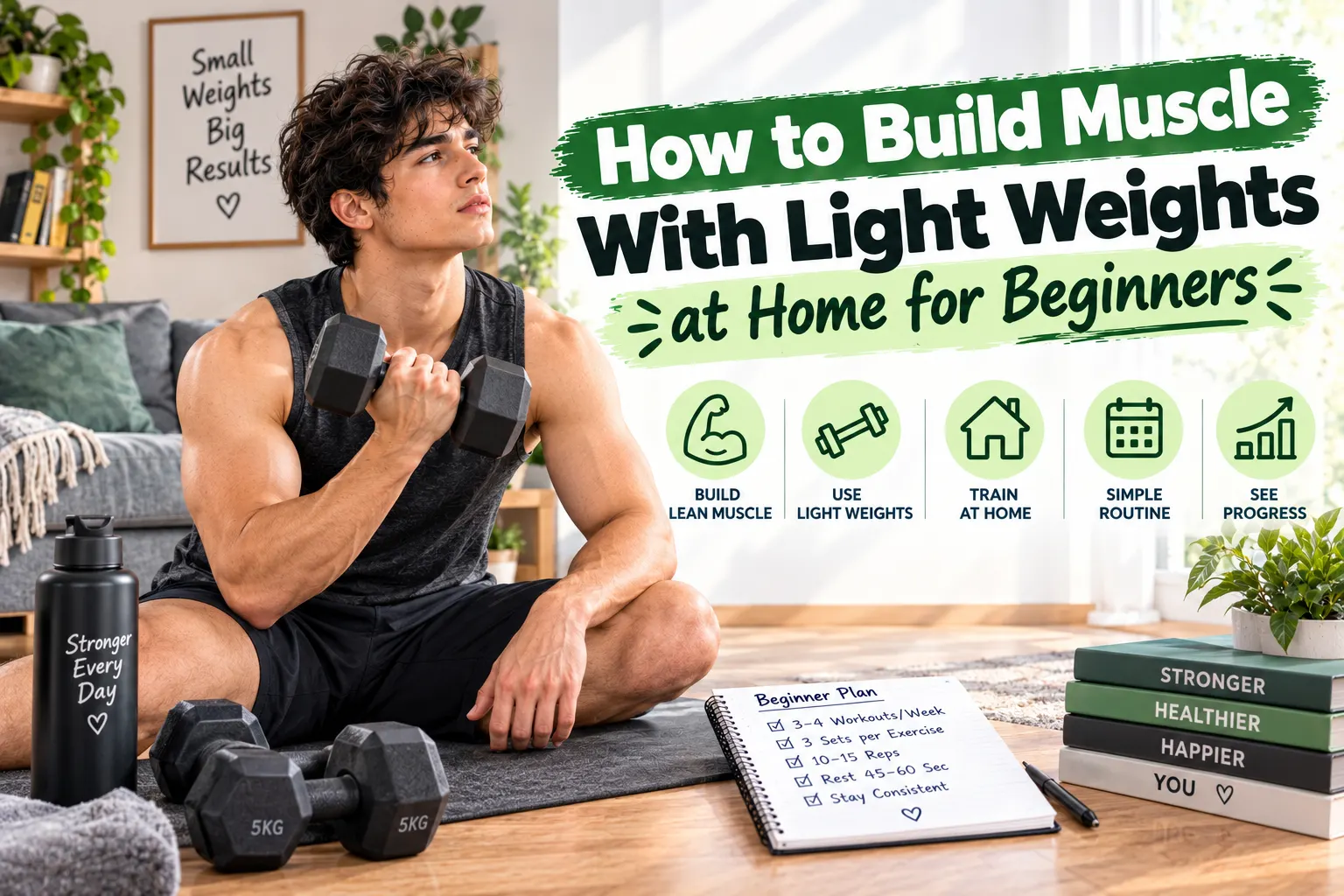
Learning how to build muscle with light weights at home for beginners is a practical way to start strength training without investing in expensive gym equipment. A pair of light dumbbells, resistance bands, or even suitable household items can help you develop strength and gradually build muscle when you use them consistently and challenge your muscles appropriately.
You do not necessarily need heavy weights to make progress. The key is choosing effective exercises, maintaining proper form, performing enough challenging repetitions, eating nutritious meals, and allowing your muscles time to recover.
Whether you are new to fitness or returning after a long break, a simple home workout routine can help you establish sustainable training habits and work toward your muscle-building goals.
Can You Build Muscle With Light Weights at Home?
Yes, beginners can build muscle with light weights at home. Lighter resistance can stimulate muscle growth when your exercises are sufficiently challenging, your technique is controlled, and you gradually increase the difficulty as your strength improves.
The weight itself is only one part of an effective workout. Your muscles also respond to training effort, exercise selection, training consistency, and recovery.
However, weights that are too light to challenge your muscles may eventually limit progress. As you become stronger, you may need additional resistance, more challenging exercise variations, or other ways to increase training difficulty.
For beginners, light weights offer a manageable starting point for learning movement patterns and developing confidence before progressing to heavier resistance.
1. Choose the Right Light Weights for Muscle Growth
You do not need a complete home gym to begin strength training. Start with equipment that allows you to perform each exercise through a comfortable range of motion while maintaining control.
Adjustable dumbbells are useful because you can increase resistance gradually. Resistance bands are another versatile option, while a sturdy chair and a mat can support several beginner-friendly exercises.
When selecting your weights, consider how the final repetitions of a set feel. The resistance should be challenging enough that completing additional repetitions would become difficult, while your technique remains stable.
If you can perform many more repetitions without meaningful effort, the weight may be too light for that exercise.
Never sacrifice proper form simply to lift more weight or complete additional repetitions. If you experience sharp pain, dizziness, or unusual discomfort, stop the exercise and seek appropriate advice if symptoms persist.
2. Follow a Beginner-Friendly Home Strength Training Routine
A balanced workout should train the major muscle groups, including your chest, back, shoulders, arms, legs, and glutes. Combining pushing, pulling, and lower-body movements helps develop more balanced strength than repeatedly exercising only one area.
Start with two or three nonconsecutive strength-training sessions per week. This gives beginners time to practice their technique while allowing recovery between workouts.
Simple Full-Body Workout With Light Weights
<text color=”secondary” size=”sm”>Beginner routine · Approximately 25–35 minutes</text>
| Exercise | Sets | Repetitions |
|---|---|---|
| Dumbbell squats | 2–3 | 10–15 |
| Dumbbell floor press | 2–3 | 10–15 |
| One-arm dumbbell rows | 2–3 | 10–15 per side |
| Dumbbell shoulder press | 2 | 10–12 |
| Dumbbell Romanian deadlifts | 2–3 | 10–15 |
| Dumbbell biceps curls | 2 | 12–15 |
Rest for approximately 60–120 seconds between sets, or longer if you need to regain comfortable breathing and maintain good technique. The repetition ranges are starting points, not strict requirements.
If an exercise feels too difficult, reduce the resistance or use an easier variation. If it feels too easy, first make sure your technique is correct before increasing repetitions or resistance.
Warm up for five minutes with gentle marching, arm circles, bodyweight squats, and other comfortable movements.
3. Use Progressive Overload to Keep Building Muscle
Progressive overload means gradually increasing the challenge placed on your muscles as your body adapts to training. It is one of the most important principles for continuing to build muscle with light weights.
Repeating exactly the same easy workout indefinitely may help maintain activity, but it can eventually provide too little stimulus for further muscle growth.
You can progress without immediately buying heavier equipment. Try these approaches:
- Increase repetitions: Move from 10 controlled repetitions to 12 or 15 when appropriate.
- Add a set: Increase from two sets to three if you can recover comfortably.
- Improve technique: Use a controlled movement and a comfortable, consistent range of motion.
- Choose harder variations: Progress from an easier movement to a more challenging version when you are ready.
- Increase resistance: Use heavier dumbbells or a stronger resistance band when the current load becomes too easy.
Change one variable at a time so you can evaluate how your body responds.
Slowing down the lowering phase can make an exercise more demanding, but extremely slow repetitions are not essential. Focus on controlled movement, adequate effort, and steady progress rather than complicated training techniques.
4. Improve Your Repetitions and Training Technique
Good technique helps you train the intended muscles and makes your workouts more consistent. It also reduces the likelihood of losing control of the weight when fatigue sets in.
During each repetition, maintain a stable position, avoid unnecessary swinging, and move through a comfortable range of motion. Breathe continuously rather than holding your breath throughout a set.
For example, during a dumbbell curl, keep your elbows relatively close to your sides and avoid rocking your torso to lift the weights. During a dumbbell row, maintain a stable back position and pull the weight toward your hip without twisting your body excessively.
You should feel your muscles working, but sharp or persistent joint pain is not a sign of an effective workout.
If you are unsure about your technique, use a mirror, record a set for your own review, or ask a qualified fitness professional for guidance.
5. Eat Enough Protein and Balanced Meals
Muscle growth requires more than exercise. Your body needs sufficient energy, protein, and other nutrients to repair and adapt to strength training.
Protein provides amino acids that help support muscle repair and growth. Useful sources include eggs, chicken, fish, milk, yogurt, beans, lentils, tofu, and other protein-rich foods.
For many healthy adults who regularly strength train, approximately 1.4–2.0 grams of protein per kilogram of body weight per day can be a useful general range. Individual requirements vary, and people with certain medical conditions may need personalized dietary advice.
You do not have to rely on expensive supplements to get started. Ordinary meals can provide protein alongside carbohydrates, healthy fats, vitamins, and minerals.
For example, a beginner-friendly daily eating pattern might include eggs and whole-grain bread at breakfast, lentils with rice or roti at lunch, yogurt or fruit as a snack, and chicken, beans, or tofu with vegetables at dinner.
Eat enough to support your activity and recovery. Avoid aggressive calorie restriction if your priority is building muscle, and remember that supplements are not a substitute for a balanced diet.
6. Prioritize Muscle Recovery and Sleep
Muscles adapt to training during the recovery process, making rest an essential part of a muscle-building routine. Exercising hard every day without adequate recovery can leave you fatigued and make it more difficult to maintain performance.
Allow approximately 48 hours before training the same muscle groups hard again, adjusting your schedule according to workout intensity and individual recovery. Light walking and gentle mobility exercises can be useful on rest days.
Sleep also matters. Most adults need seven to nine hours per night, although teenagers generally need more. Establish a regular sleep schedule and avoid sacrificing sleep to squeeze in additional workouts.
Pay attention to persistent soreness, declining performance, unusual fatigue, and difficulty recovering between sessions. These can be signs that your training demands need adjusting.
Consistent workouts, sufficient food, and adequate rest are generally more useful than attempting to train intensely every day.
7. Common Mistakes Beginners Should Avoid
Several common mistakes can slow progress when building muscle with light weights at home.
Choosing weights that are too easy: If every set feels effortless, gradually increase the challenge while maintaining good form.
Training only visible muscles: Include exercises for your legs, back, chest, shoulders, and arms rather than focusing exclusively on biceps or abdominal muscles.
Expecting immediate results: Muscle growth takes time. Your progress depends on training consistency, nutrition, sleep, genetics, and starting fitness level.
Ignoring recovery: More training is not always better. Your muscles need time and adequate nourishment to adapt.
Changing routines too frequently: Give yourself enough time to practice exercises and measure improvements before replacing your entire program.
Keep a simple workout log with your exercises, weights, repetitions, and sets. Reviewing your progress every few weeks can help you identify improvements that might otherwise go unnoticed.
Build Muscle at Home With Consistency
Building muscle with light weights at home is achievable for many beginners when training is challenging, progressive, and supported by good nutrition and recovery.
Start with a manageable full-body routine, train two or three times per week, and focus on proper technique. As exercises become easier, gradually increase repetitions, sets, or resistance.
You do not need expensive equipment or a complicated training plan to begin. Consistent effort, realistic expectations, and a willingness to progress gradually can help you develop a stronger foundation for long-term fitness.
Frequently Asked Questions
1. How long does it take to build muscle with light weights at home?
Beginners may notice improvements in strength and exercise control within the first several weeks, while visible muscle changes often take longer. The timeline depends on your starting fitness level, training consistency, nutrition, sleep, genetics, and how challenging your workouts are. Track improvements in repetitions, resistance, and technique rather than relying only on appearance.
2. How many repetitions should beginners do with light weights?
A practical starting point is around 10–15 repetitions per set, using a weight that makes the final repetitions challenging without compromising technique. Some people may benefit from higher repetitions with lighter resistance. The key is sufficient muscular effort, not reaching a specific repetition number at any cost.
3. Can I build muscle at home without dumbbells?
Yes. Bodyweight exercises such as squats, push-ups, lunges, and glute bridges can build strength when they provide enough challenge. Resistance bands and suitable household equipment can offer additional options. As your strength improves, you may need more difficult exercise variations or added resistance to continue progressing.
4. Should I use light weights every day to build muscle faster?
No. Training the same muscles hard every day is not necessary and may interfere with recovery. Beginners can often start with two or three nonconsecutive full-body strength sessions per week. On other days, consider walking or gentle mobility work. Adjust your schedule according to your fitness level, soreness, energy, and recovery.
5. Do I need protein powder to build muscle with light weights?
No. Protein powder is optional, not essential. Foods such as eggs, dairy products, lentils, beans, fish, chicken, and tofu can provide the protein needed to support muscle growth. Supplements may be convenient if meeting your needs through food is difficult, but your overall diet, training quality, and recovery matter more than using a particular product.