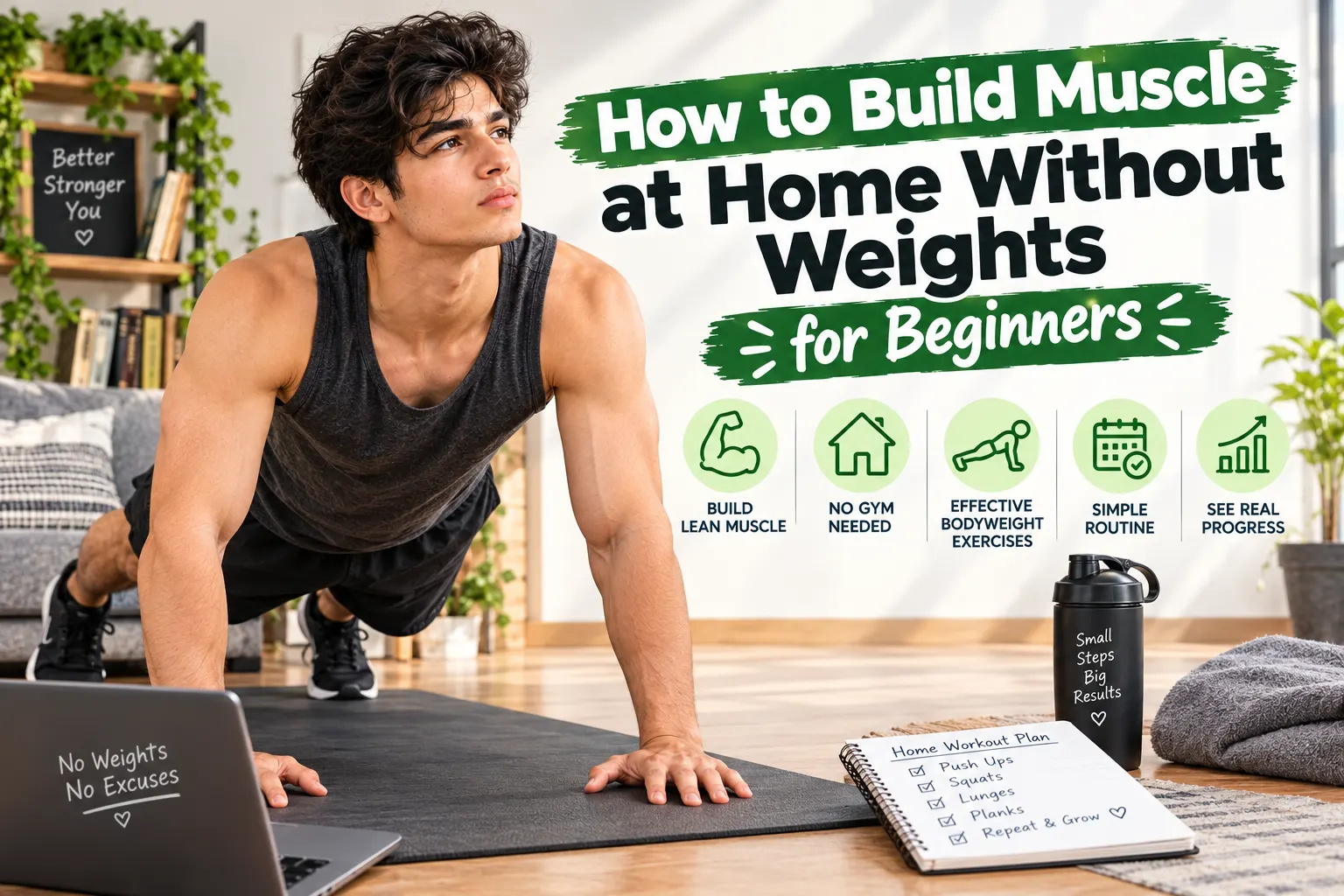
Learning how to build muscle at home without weights is possible with simple bodyweight exercises, consistent training, and proper nutrition. You do not need a gym membership, dumbbells, or expensive equipment to begin developing strength. Exercises such as push-ups, squats, lunges, and planks can help beginners build a strong foundation using their own body weight.
The key is to challenge your muscles regularly and gradually make exercises more difficult as your strength improves. Combined with enough protein, adequate calories, and sufficient rest, bodyweight training can support muscle growth and improve overall fitness.
Whether you are starting your fitness journey or prefer exercising at home, this guide explains how to train effectively, structure a beginner workout, and make progress without weights.
Can You Build Muscle at Home Without Weights?
Yes, beginners can build muscle at home without weights by performing challenging bodyweight exercises and increasing their difficulty over time. Your muscles respond to resistance and progressive overload, not simply to the presence of gym equipment.
Exercises such as push-ups train the chest, shoulders, and triceps, while squats and lunges work the lower body. Planks and other core exercises help develop abdominal strength and stability.
However, progress depends on several factors, including exercise technique, training consistency, nutrition, recovery, and your starting fitness level. As your body adapts, you may need harder exercise variations or additional resistance to keep challenging your muscles.
Best Bodyweight Exercises for Muscle Growth
A balanced home workout should target the major muscle groups rather than focusing on only one area. Beginners can start with these exercises and adjust the difficulty to match their current ability.
1. Push-Ups for Chest, Shoulders, and Triceps
Push-ups are one of the most useful upper-body exercises for home training. They engage the chest, shoulders, triceps, and core muscles while requiring no equipment.
Start with wall push-ups or incline push-ups using a stable, elevated surface if standard push-ups are too difficult. As you improve, gradually progress to floor push-ups.
Keep your body aligned, lower yourself under control, and avoid allowing your hips to sag. Quality repetitions are more valuable than rushing through a large number.
2. Bodyweight Squats for Stronger Legs
Bodyweight squats strengthen the quadriceps, glutes, and other muscles involved in lower-body movement. They also help beginners practice balance and movement control.
Stand with your feet approximately shoulder-width apart, bend your knees and hips, and lower yourself as far as you can comfortably maintain good form. Push through your feet to return to standing.
Begin with two or three sets of 8–15 repetitions. If squats become easy, try slower lowering phases, pause squats, or more challenging single-leg variations when you have sufficient balance and control.
3. Lunges for Legs and Glutes
Lunges train the quadriceps and glutes while challenging coordination and balance. They are a useful addition to squats because they train each leg individually.
Step forward, lower your body under control, and push back to your starting position. Keep your front knee aligned with your foot and use a comfortable range of motion.
Start with stationary lunges if stepping forward and backward feels unstable. Perform 8–12 repetitions per leg, adjusting the number according to your fitness level.
4. Planks for Core Strength
Planks help develop core endurance and stability. A stronger core supports controlled movement during push-ups, squats, and other exercises.
Place your forearms on the floor, extend your legs, and keep your body in a straight line. Avoid raising your hips excessively or allowing your lower back to sag.
Hold the position for 15–30 seconds initially. Gradually increase the duration while maintaining good form rather than holding the plank until your technique breaks down.
5. Glute Bridges for the Hips
Glute bridges target the glutes and support hip extension. They are particularly useful for beginners who want to strengthen the lower body without jumping or using equipment.
Lie on your back with your knees bent and feet flat on the floor. Lift your hips until your shoulders, hips, and knees form a comfortable line, squeeze your glutes briefly, and lower yourself slowly.
Start with 10–15 repetitions. Once the movement becomes easy, pause at the top or progress to single-leg glute bridges if you can perform them safely.
A Simple Beginner Home Workout Routine
You can begin with three nonconsecutive workout days per week, allowing recovery time between sessions. The following routine covers the major muscle groups without requiring weights.
| Exercise | Sets | Repetitions or time |
|---|---|---|
| Push-ups or incline push-ups | 2–3 | 6–12 reps |
| Bodyweight squats | 2–3 | 10–15 reps |
| Lunges | 2 | 8–12 per leg |
| Glute bridges | 2–3 | 10–15 reps |
| Plank | 2–3 | 15–30 seconds |
Rest for approximately 60–120 seconds between sets, or longer if necessary to maintain good technique. Warm up for five minutes with gentle marching, arm circles, and controlled bodyweight movements before starting.
Choose a variation that allows you to complete the prescribed repetitions with good form. If you cannot perform the minimum repetitions comfortably, use an easier variation.
This routine is a starting point, not a requirement to train through pain or exhaustion. Reduce the volume if you are very sore or struggling to recover.
Progressive Overload Without Gym Equipment
Progressive overload means gradually increasing the challenge placed on your muscles as your strength improves. It is essential for continued progress because repeating the same easy workout indefinitely may eventually produce limited results.
You can apply progressive overload at home in several ways:
- Increase repetitions: Progress from 8 controlled push-ups to 10 or 12.
- Add sets: Increase from two sets to three when you can recover comfortably.
- Slow down movements: Lower yourself over two or three seconds to increase control and time under tension.
- Use harder variations: Progress from wall push-ups to incline push-ups and eventually standard push-ups.
- Improve your range of motion: Gradually work through a comfortable, controlled range as mobility and strength improve.
Change one variable at a time and record your workouts. You do not need to make every session harder; consistent progress over several weeks is more useful than rushing into advanced exercises.
Nutrition for Muscle Growth at Home
Exercise provides the stimulus for muscle growth, but your diet supplies the energy and nutrients needed to support adaptation and recovery. You can meet many of these needs through affordable everyday foods.
Include protein sources such as eggs, milk, yogurt, chicken, lentils, beans, and chickpeas. For healthy adults who regularly perform resistance training, approximately 1.4–2.0 grams of protein per kilogram of body weight per day is a commonly recommended range, although individual needs vary.
Carbohydrate-rich foods such as oats, rice, potatoes, fruit, and whole grains provide energy for training. Include vegetables, healthy fats, and enough total food to support your activity level.
You do not need protein supplements to build muscle. Regular meals can provide the nutrients you need when your overall diet is appropriately planned.
Rest and Recovery for Better Results
Muscles need recovery time between challenging workouts. Beginners should generally avoid training the same muscles intensely every day, especially when they are still adapting to exercise.
Aim for consistent, sufficient sleep and include lighter days or rest days in your schedule. Gentle walking and comfortable mobility exercises can help you stay active without adding excessive training stress.
Some muscle soreness can occur after unfamiliar exercise, but sharp pain, joint pain, or worsening discomfort is a reason to stop the movement. If pain persists or you have an existing medical condition or injury, seek guidance from a qualified healthcare professional.
Common Mistakes to Avoid When Training at Home
Several habits can slow progress or make workouts less effective.
- Doing repetitions too quickly: Use controlled movements instead of sacrificing technique for speed.
- Ignoring the back muscles: Push-ups train the pushing muscles, but balanced development also requires pulling movements.
- Changing workouts constantly: Follow a consistent plan long enough to measure improvements.
- Skipping meals or protein: Inadequate nutrition can make recovery and muscle growth more difficult.
- Expecting immediate results: Strength can improve before noticeable changes in muscle size occur.
One limitation of equipment-free training is that pulling exercises are harder to perform safely without suitable equipment. If possible, use a properly installed pull-up bar or resistance bands. Avoid improvised setups involving unstable furniture or objects that could fall.
Build Muscle at Home With Consistency
Building muscle at home without weights is a practical starting point for beginners who want to become stronger without expensive equipment. Push-ups, squats, lunges, glute bridges, and planks can develop strength when performed with good technique and progressively increasing difficulty.
Combine a manageable workout routine with balanced nutrition, adequate protein, and sufficient recovery. Track your progress, remain patient, and adjust your exercises as your abilities improve. With consistent effort, bodyweight training can provide a strong foundation for long-term fitness.r beginners
Frequently Asked Questions
1. How long does it take to build muscle at home without weights?
The timeline varies depending on your starting fitness level, training consistency, nutrition, sleep, and genetics. Beginners may notice improvements in strength and exercise control within a few weeks, while visible muscle changes often take longer. Track your repetitions, exercise difficulty, and progress over time instead of relying only on appearance.
2. Can beginners build muscle at home without going to the gym?
Yes. Beginners can develop muscle and strength through challenging bodyweight exercises such as push-ups, squats, lunges, and glute bridges. A gym is not essential for getting started. However, as you become stronger, you may eventually benefit from resistance bands, a pull-up bar, or other equipment to continue challenging your muscles.
3. How many days a week should I exercise to build muscle at home?
Three nonconsecutive strength-training sessions per week can be a practical starting point for beginners. This schedule gives you regular opportunities to practice exercises while allowing time for recovery. Adjust the frequency and workout volume according to your fitness level, soreness, and ability to recover between sessions.
4. What should I eat to build muscle without weights?
Eat balanced meals containing protein, carbohydrates, healthy fats, and vegetables. Affordable options include eggs, lentils, beans, milk, yogurt, chicken, oats, rice, and potatoes. Your overall calorie intake and protein consumption should match your individual needs. Supplements are not necessary if you can meet your nutritional requirements through food.
5. Can I build muscle at home without equipment for my back and biceps?
Training the back and biceps is more challenging without equipment because these muscles perform many pulling movements. If you have a safe, suitable setup, resistance bands or a properly installed pull-up bar can help. Avoid pulling on doors, unstable furniture, or improvised objects that may fail. A balanced routine should train both pushing and pulling muscles.