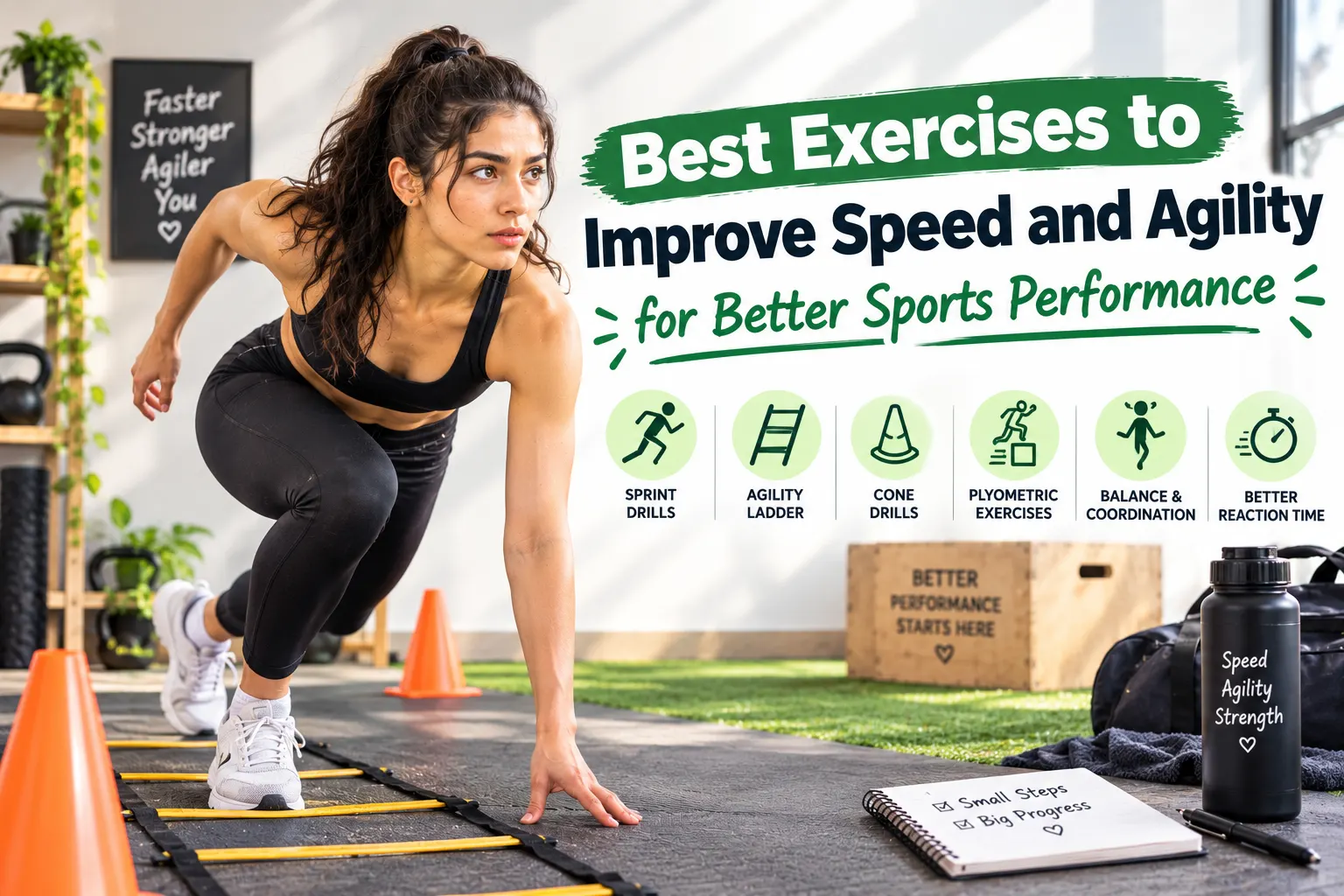
Speed and agility are essential skills in sports such as soccer, basketball, tennis, football, and track and field. Whether you want to sprint faster, change direction more efficiently, or react quickly during competition, the right exercises can help you develop these abilities over time.
The best exercises to improve speed and agility combine sprint training, explosive movements, balance drills, and controlled changes of direction. With consistent practice, proper technique, and adequate recovery, beginners and experienced athletes can build the physical skills needed for better sports performance.
Why Speed and Agility Matter in Sports
Speed is the ability to move quickly from one point to another, while agility is the ability to change direction efficiently in response to movement or changing situations. Both skills are valuable, but they require slightly different types of training.
For example, a sprinter needs acceleration and maximum running speed. A basketball player also needs lateral movement, balance, and the ability to react when an opponent changes direction.
Improving these qualities can help athletes move more efficiently, maintain better control, and perform sport-specific actions with greater confidence. However, results depend on training experience, physical conditioning, technique, and consistency.
Best Speed Training Exercises for Faster Movement
Speed training focuses on acceleration, stride mechanics, and the ability to produce force quickly. Short, high-quality repetitions are generally more useful for developing speed than repeatedly sprinting while exhausted.
1. Short-Distance Sprints
Short sprints help develop acceleration, which is especially useful when an athlete needs to reach speed quickly.
Start with a five- to ten-minute dynamic warm-up, including light jogging, leg swings, and marching drills. Then sprint for approximately 10–20 yards, gradually building speed while maintaining an upright posture and controlled arm movement.
- Perform 4–6 repetitions.
- Rest for 60–120 seconds between efforts, or longer if needed.
- Focus on powerful, controlled acceleration rather than rushing every repetition.
Beginners should start with fewer repetitions and increase training volume gradually.
2. High Knees
High knees develop running coordination, hip movement, and rhythm. They are useful as part of a warm-up or as a technique drill before sprint training.
Stand tall and alternate lifting your knees while moving your arms naturally. Begin slowly, then increase the pace without leaning backward or losing control of your movements.
Try two or three rounds of 15–20 seconds. Keep the effort controlled enough to maintain proper technique.
3. A-Skips
A-skips are a running drill that combines alternating knee lifts with coordinated arm action and a light skipping motion. They help athletes practice rhythm, posture, and foot placement.
Move forward with short, controlled skips, lifting one knee while driving the opposite arm. Land lightly and maintain a consistent rhythm.
Perform two or three sets of 10–15 yards before sprinting. Focus on coordination rather than jumping as high as possible.
Agility Ladder Drills for Better Footwork
Agility ladder drills can improve footwork patterns, movement coordination, and body control. They are particularly useful for beginners learning to move their feet quickly and accurately.
However, performing ladder drills alone does not fully develop reactive agility. Athletes also need to practice accelerating, braking, and responding to unpredictable movement.
4. Single-Step Ladder Drill
Place an agility ladder on a flat, nonslip surface. Step into each square with one foot, alternating feet as you move forward.
Start at a comfortable pace and avoid looking down throughout the entire drill. Once the pattern feels natural, gradually increase your speed while keeping your steps accurate.
Complete two or three passes through the ladder. If your feet repeatedly hit the rungs, slow down until you can perform the movement cleanly.
5. Lateral Ladder Steps
Lateral ladder steps develop side-to-side coordination, which can support movement in sports such as basketball, tennis, and soccer.
Stand beside the ladder and step sideways through each square using a controlled, repeating pattern. Keep your knees slightly bent and your torso stable.
Perform two or three passes in each direction. Prioritize balance and precise foot placement over speed.
Cone Drills to Improve Change of Direction
Cone drills teach athletes to accelerate, decelerate, and move between different positions. They are particularly valuable because many sports require rapid direction changes rather than straight-line running alone.
6. The 5-10-5 Shuttle Run
The 5-10-5 shuttle run is a common change-of-direction drill. It involves moving five yards in one direction, ten yards in the opposite direction, and five yards back to the starting point.
Set three markers in a straight line, with five yards between the center marker and each outside marker. Begin at the middle, sprint to one outside marker, reverse direction toward the other outside marker, and finish at the center.
Start with two or three repetitions, resting between attempts. Learn to lower your center of gravity, plant your foot securely, and push away from the ground without twisting your knee excessively.
7. T-Drill
The T-drill combines forward sprinting, lateral shuffling, and backward movement. It helps athletes practice several movement patterns within a single exercise.
Arrange four cones in a T shape. Sprint forward to the middle cone, shuffle sideways to one end, shuffle across to the other end, return to the middle, and move backward to the starting point.
Complete two or three repetitions with adequate rest. Move slowly enough at first to maintain balance and learn the correct sequence.
Plyometric Exercises for Explosive Sports Performance
Plyometric exercises use rapid muscle actions to develop explosive power. This quality supports acceleration, jumping, and quick changes in direction.
Because these movements place greater demands on muscles, tendons, and joints, beginners should learn basic landing mechanics before progressing to intense or repeated jumps.
8. Squat Jumps
Squat jumps help develop lower-body power. Stand with your feet approximately shoulder-width apart, lower into a comfortable squat, and jump upward.
Land softly with your knees slightly bent, keeping your feet stable and your knees aligned with your toes. Reset your position before performing the next repetition.
Start with two sets of five jumps. Stop if your landings become heavy or your technique deteriorates.
9. Skater Jumps
Skater jumps develop lateral power and single-leg balance, both of which can be useful in court and field sports.
Jump sideways from one foot to the other, landing with control on the opposite leg. Keep your hips stable and avoid allowing your knee to collapse inward.
Begin with two sets of five jumps per side. Use smaller jumps until you can maintain balance throughout each landing.
How to Build a Weekly Speed and Agility Routine
You do not need to perform every drill in one workout. A focused routine that combines a few exercises is easier to manage and allows you to practice each skill with better technique.
Here is a simple beginner session:
| Exercise | Suggested volume |
|---|---|
| Dynamic warm-up | 5–10 minutes |
| A-skips | 2 sets of 10 yards |
| Short-distance sprints | 4 repetitions |
| Lateral ladder steps | 2 passes per direction |
| 5-10-5 shuttle run | 2 repetitions |
| Squat jumps | 2 sets of 5 reps |
Rest adequately between demanding efforts. This session can take approximately 20–35 minutes, depending on your pace and recovery periods.
Beginners can start with one or two speed and agility sessions per week, leaving recovery time between demanding workouts. Avoid scheduling intense sprinting and jumping sessions on consecutive days until your body is accustomed to the workload.
As your fitness improves, you can add more repetitions, introduce sport-specific drills, or gradually increase movement complexity.
Recovery, Nutrition, and Injury Prevention
Training quality depends on more than the exercises themselves. Recovery allows your body to adapt to demanding movements and helps you return to future sessions ready to perform.
Prioritize consistent sleep, balanced meals, adequate hydration, and rest between high-intensity efforts. Include protein-rich foods, carbohydrates, fruits, vegetables, and other nutrient-dense options to support training and recovery.
Before each session, warm up with light aerobic movement and dynamic mobility exercises. Avoid starting with maximal sprints or explosive jumps when your muscles are cold.
Pay attention to persistent pain, unusual swelling, or discomfort that changes your running mechanics. Stop the activity if symptoms develop, and consult a qualified healthcare professional when appropriate. Athletes with existing injuries or medical conditions may need individualized training guidance.
Common Mistakes That Limit Speed and Agility Progress
Even good exercises can become less effective when technique and recovery are neglected.
Avoid these common mistakes:
- Training at maximum intensity every day: Frequent high-intensity sessions can limit recovery and reduce movement quality.
- Ignoring braking technique: The ability to slow down under control is essential before attempting aggressive direction changes.
- Prioritizing speed over form: Sloppy footwork and unstable landings can increase unnecessary stress on the body.
- Skipping the warm-up: Prepare your muscles and joints before sprinting or jumping.
- Repeating drills without progression: Increase difficulty gradually instead of adding large amounts of training volume at once.
Track simple measures, such as sprint times over a consistent distance or the number of controlled repetitions you can complete. Reassess periodically under similar conditions rather than judging progress from a single session.
Build Better Sports Performance One Session at a Time
The best exercises to improve speed and agility include short sprints, running drills, ladder movements, cone drills, and controlled plyometric exercises. Each develops a different part of athletic movement, from acceleration and coordination to explosive power and directional control.
Start with a manageable routine, practice proper technique, and allow enough time for recovery. As your skills improve, adapt your training to the demands of your sport and build intensity gradually.
Consistency matters more than doing every drill at once. A focused training plan can help you develop better movement quality and work toward stronger sports performance over time.
Frequently Asked Questions
1. What are the best exercises to improve speed and agility?
Short-distance sprints, agility ladder drills, cone drills, shuttle runs, and controlled plyometric exercises are useful options. Sprints develop acceleration, ladder drills improve footwork coordination, and cone drills practice changes of direction. Choose exercises that match your sport, training experience, and current fitness level.
2. How often should I train for speed and agility?
Beginners can generally start with one or two focused sessions per week, allowing recovery between demanding workouts. The appropriate frequency depends on your other training, sports schedule, sleep, and fitness level. Increase training gradually, and avoid performing intense sprinting and jumping sessions on consecutive days when you are not accustomed to them.
3. Can agility ladder drills make me faster?
Agility ladder drills can improve coordination, rhythm, and footwork, but they do not develop every component of speed. To improve sprinting ability, include short sprints and appropriate acceleration drills. To improve game-specific agility, practice controlled changes of direction and reaction drills that reflect the movements required by your sport.
4. How long does it take to improve speed and agility?
Some beginners notice better coordination and confidence after several weeks of consistent practice, while measurable improvements in sprint speed or change-of-direction performance may take longer. Results depend on your starting fitness, technique, training frequency, recovery, and sport. Use consistent testing conditions to evaluate progress rather than expecting immediate changes.