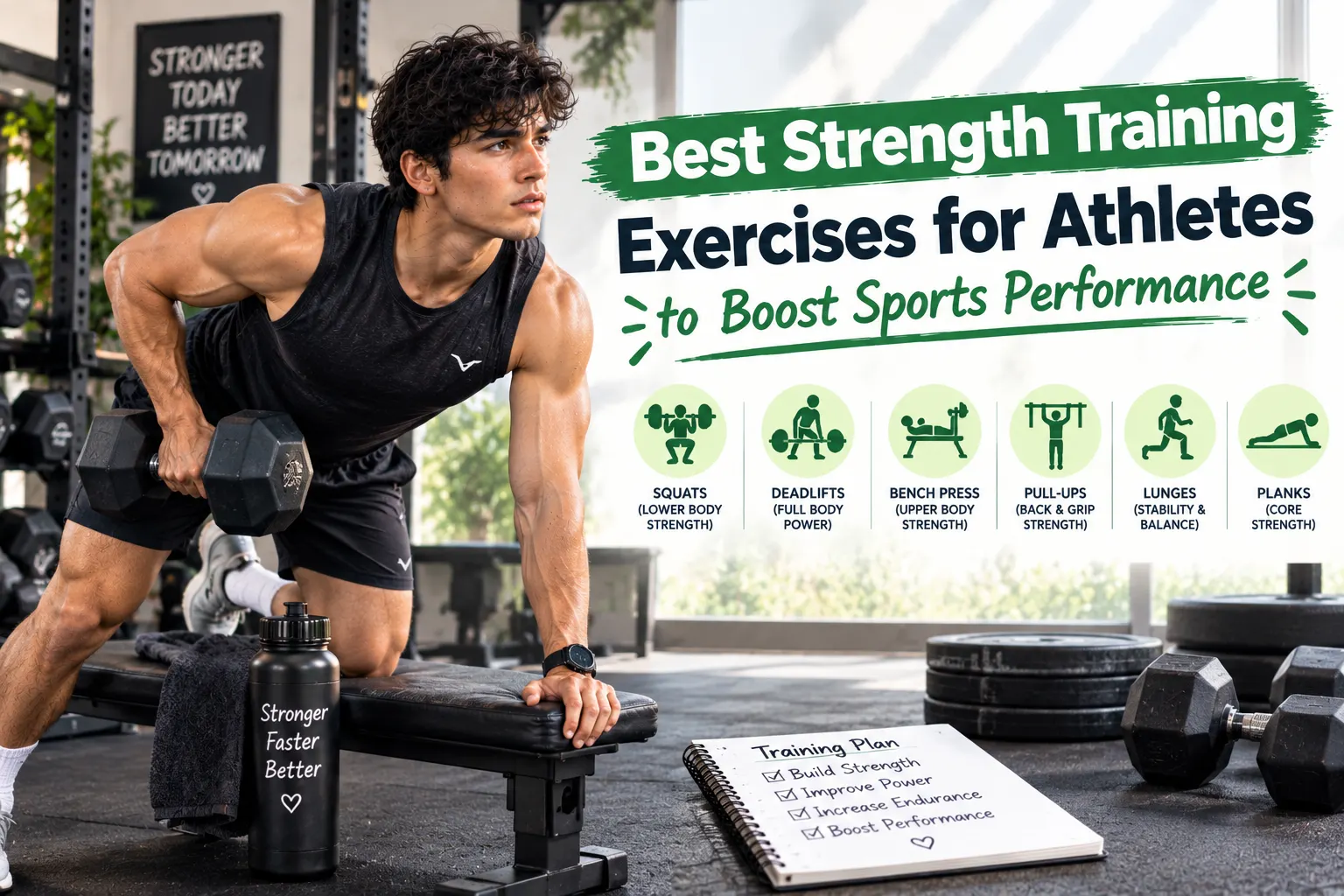
Strength training is a vital part of athletic development, helping athletes build power, improve speed, increase muscular endurance, and perform more effectively during competition. The right exercises can also improve balance, coordination, and the ability to generate force during explosive movements such as sprinting, jumping, throwing, and changing direction.
The best strength training exercises for athletes focus on developing the entire body rather than building muscle size alone. By combining compound lifts, unilateral movements, core exercises, and explosive drills, athletes can develop strength that transfers to their sport. The key is choosing exercises that match individual goals, training experience, and physical demands.
Why Strength Training Matters for Athletic Performance
Strength training helps athletes produce more force, control their movements, and maintain performance during demanding training sessions and competitions. It supports the physical qualities required in sports such as soccer, basketball, football, tennis, track and field, and martial arts.
Regular resistance training can contribute to several athletic benefits:
- Greater muscular strength: Stronger muscles help athletes push off the ground, resist opponents, and handle physical demands more effectively.
- Improved explosive power: Developing strength can support faster acceleration, higher jumps, and more forceful movements when combined with power training.
- Better movement control: Exercises that challenge balance and coordination help athletes manage complex movements.
- Injury risk management: Appropriate strength training can improve the capacity of muscles and connective tissues to tolerate sporting demands, although it cannot eliminate injury risk.
- Improved muscular endurance: Repeated resistance exercises can help athletes sustain force production during prolonged activity.
Strength training should complement sport-specific practice, conditioning, technical drills, and recovery. The goal is to become stronger and more capable without accumulating unnecessary fatigue that interferes with performance.
Best Compound Strength Training Exercises for Athletes
Compound exercises involve multiple joints and muscle groups working together. They are particularly useful for developing foundational strength because many athletic movements also require coordinated force production across the hips, legs, trunk, and upper body.
1. Squats
Squats strengthen the quadriceps, glutes, and other muscles involved in lower-body movement. These muscles contribute to sprint acceleration, jumping, landing, and changing direction.
Athletes can use back squats, front squats, or goblet squats depending on their experience, mobility, and available equipment. Beginners should prioritize controlled movement, stable foot placement, and a comfortable range of motion before increasing the load.
2. Deadlifts
Deadlifts develop the posterior chain, including the glutes, hamstrings, and back muscles. This strength is valuable for producing force through the hips and maintaining control when lifting, accelerating, or engaging in physically demanding sports.
Conventional deadlifts, trap-bar deadlifts, and Romanian deadlifts offer different training benefits. Athletes should select a variation they can perform safely and consistently, with particular attention to bracing and maintaining a controlled spinal position.
3. Bench Press
The bench press strengthens the chest, shoulders, and triceps. It can support pushing movements used in contact sports, wrestling, and other activities that require upper-body force.
Dumbbell bench presses provide an alternative for athletes who prefer independent arm movement. Regardless of the variation, controlled repetitions and stable shoulder positioning should take priority over lifting the heaviest possible weight.
4. Pull-Ups and Rows
Pull-ups develop the upper back, latissimus dorsi, and arm muscles, while rows strengthen the muscles responsible for pulling and controlling the shoulder blades.
These exercises help balance upper-body training and support climbing, grappling, swimming-related strength demands, and general shoulder control. Athletes who cannot perform full pull-ups can begin with assisted variations or lat pulldowns.
Explosive Power Training for Speed and Jumping Ability
Explosive power is the ability to produce force quickly. It matters in sprinting, jumping, throwing, striking, and rapid changes of direction. Developing maximal strength provides a foundation, while appropriately programmed explosive exercises train athletes to apply that strength at higher movement speeds.
5. Box Jumps
Box jumps train rapid force production through the lower body. They can help athletes practice explosive hip, knee, and ankle extension while coordinating takeoff and landing.
Choose a box height that allows a controlled jump and stable landing. Jump down carefully or step off instead of repeatedly dropping from a high box, particularly when fatigue begins to affect technique.
6. Medicine Ball Throws
Medicine ball chest passes, overhead throws, and rotational throws develop explosive upper-body and trunk movement. Rotational variations are especially relevant to sports that involve striking, throwing, or rapidly turning the torso.
Use a suitable ball weight that allows fast, controlled repetitions. A ball that is too heavy may slow the movement and reduce the emphasis on power.
7. Kettlebell Swings
Kettlebell swings emphasize rapid hip extension and coordination between the hips and trunk. They can support posterior-chain development and explosive hip movement when performed with sound technique.
The movement should be driven primarily by the hips rather than by lifting the kettlebell with the arms. Athletes new to kettlebell training should learn the hip hinge before adding speed or heavier resistance.
Explosive exercises are generally best performed early in a workout, when the athlete is relatively fresh. Stop a set when jump height, movement speed, or technique noticeably declines.
Unilateral Exercises for Balance and Athletic Stability
Many sports involve running, jumping, landing, and pushing off one leg at a time. Unilateral strength exercises help athletes develop each leg independently, address side-to-side differences, and improve control during single-leg movements.
8. Bulgarian Split Squats
Bulgarian split squats challenge the quadriceps and glutes while requiring balance and trunk stability. They are useful for developing single-leg strength that can complement sprinting, jumping, and cutting movements.
Start with body weight or light dumbbells, maintain a stable front foot, and lower under control. Adjust the rear-foot elevation and stance length to find a comfortable position.
9. Single-Leg Romanian Deadlifts
This exercise targets the hamstrings and glutes while challenging balance and hip control. It also encourages athletes to maintain a stable pelvis as the body moves around one supporting leg.
Begin with body weight or a light dumbbell. Keep a slight bend in the standing knee, move through the hips, and avoid rotating the torso to compensate for limited balance.
Core Strength Exercises for Stability and Force Transfer
The core includes muscles around the abdomen, back, pelvis, and hips. These muscles help transfer force between the upper and lower body while resisting unwanted movement during running, lifting, throwing, and contact.
Effective core training should include more than repeated crunches. Exercises that challenge the body to resist rotation, extension, and sideways bending can build useful trunk control.
- Planks: Develop the ability to maintain a stable trunk under sustained tension.
- Pallof presses: Train resistance to rotation, which is useful for controlling the torso during dynamic movements.
- Side planks: Challenge the lateral trunk muscles and support control of the pelvis.
- Dead bugs: Develop coordination between the limbs and trunk while maintaining a controlled spinal position.
Choose exercises that match your sport and current ability. Focus on maintaining proper alignment rather than extending the duration of every set indefinitely.
How Athletes Should Structure a Strength Training Workout
A productive athletic strength workout combines foundational lifts with supporting exercises while leaving enough energy for sport-specific training and recovery.
A practical session can follow this order:
- Dynamic warm-up: Spend approximately 5–10 minutes preparing with light movement, mobility drills, and exercise-specific warm-up sets.
- Explosive movements: Perform box jumps or medicine ball throws while fresh, if they suit your training goals.
- Main strength exercises: Choose a squat or deadlift variation and an upper-body push or pull.
- Unilateral training: Add split squats or single-leg Romanian deadlifts.
- Core stability: Finish with planks, Pallof presses, or another appropriate trunk exercise.
The following starting guidelines can help structure training:
| Exercise type | Suggested sets | Repetitions |
|---|---|---|
| Main strength lifts | 3–4 | 4–8 |
| Unilateral exercises | 2–3 | 6–10 per side |
| Explosive exercises | 3–4 | 3–5 |
| Core stability exercises | 2–3 | 20–40 seconds or 8–12 reps |
These are general starting ranges, not fixed requirements. Explosive work should remain fast and technically sound, while strength exercises should use loads appropriate to the athlete’s experience and goals.
Common Strength Training Mistakes Athletes Should Avoid
Even effective exercises can produce poor results when training is not planned around athletic demands.
Avoid these common mistakes:
- Training to exhaustion every session: Excessive fatigue can interfere with speed work, technical practice, and recovery.
- Increasing weight too quickly: Progress gradually while maintaining proper technique and a consistent range of motion.
- Ignoring mobility and movement quality: Address relevant restrictions rather than forcing uncomfortable positions under heavy loads.
- Neglecting recovery: Adequate sleep, nutrition, hydration, and rest between demanding sessions support adaptation.
- Using the same program for every sport: A sprinter, swimmer, basketball player, and wrestler have different physical requirements.
Athletes with existing injuries, chronic health conditions, or persistent pain should seek guidance from a qualified healthcare professional or sports physiotherapist before changing their training significantly. Beginners may also benefit from supervision by a qualified strength and conditioning coach.
Build a Stronger Foundation for Sports Performance
The best strength training exercises for athletes develop more than muscular strength. Squats, deadlifts, presses, pull-ups, unilateral movements, explosive drills, and core stability exercises can work together to improve force production, movement control, and physical readiness for sport.
Consistency and appropriate progression matter more than constantly changing exercises or lifting maximal weights. Choose movements that match your sport, maintain sound technique, and balance strength work with speed training, skill practice, and recovery. A well-planned program can help athletes build a stronger foundation for long-term performance.
Frequently Asked Questions
1. What are the best strength training exercises for athletes?
Squats, deadlifts, bench presses, pull-ups, split squats, and rows are excellent foundational exercises for many athletes. Box jumps and medicine ball throws can complement these lifts by developing explosive power, while planks and Pallof presses improve trunk stability. The best combination depends on the sport, training experience, equipment, and individual goals.
2. How many days a week should athletes do strength training?
Many athletes can benefit from two or three strength training sessions per week, although the ideal frequency depends on competition schedules, training experience, and total workload. Sessions should be coordinated with sport-specific practices and recovery needs. During demanding competition periods, athletes may need shorter or less frequent sessions to manage fatigue.
3. Does strength training make athletes slower?
Strength training does not automatically make athletes slower. Developing strength can improve force production and support acceleration when combined with sprinting, jumping, and sport-specific practice. Problems are more likely when excessive training fatigue, unnecessary weight gain, or inadequate speed work interferes with performance. A balanced program develops strength without neglecting movement speed.